Skip to content

Posts from the "San Mateo County" Category

4 Comments

East Palo Alto Considers Options for Bike/Ped Bridge Over Highway 101

Photosims of EPA 101 Bike/Ped Bridge Landings

Alta Planning + Design's rendering of different options for a future bicycle/pedestrian bridge over Highway 101 in East Palo Alto. Images: Alta

The dream of reconnecting the two halves of East Palo Alto divided by Highway 101 with a bicycle/pedestrian bridge moved one step closer to reality last month with the release of the project’s draft feasibility study [PDF].

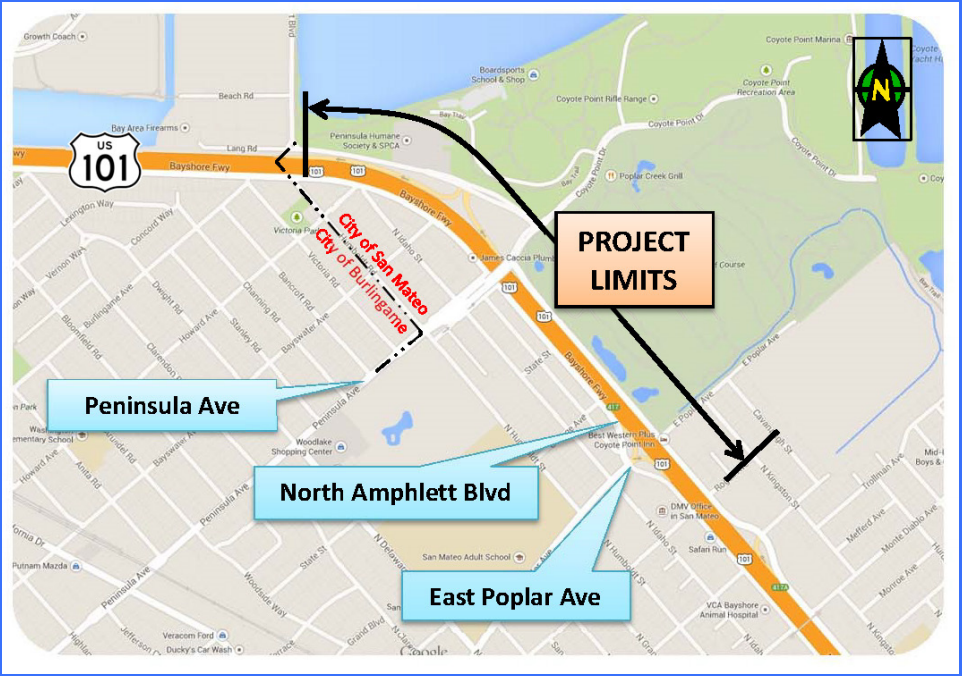
EPA 101 Bike/Ped Bridge Fives Alignments Map

Five alignments for the bicycle/pedestrian bridge were analyzed in the feasibility study.

Alta Planning + Design, which conducted the $300,000 study, examined five different possible alignments for the bridge, which are estimated to cost between $6.5 million and $9.5 million to design and construct. According to Alta’s estimates, the bridge would be used for 130,000 to 230,000 trips per year (350 to 630 per day) — an unusually high volume for bike/ped bridges due to the dense residential and commercial development on either side of the highway.

EPA City Council members who reviewed the study at a meeting last Tuesday didn’t indicate a preference for any of the bridge designs, though all four of those present voiced their support for the project (one, David Woods, was absent).

“The current overpass over the 101 freeway is not safe,” said Council Member Laura Martinez. “I see this project as a solution to get our residents across town. This is a major connection for our residents to get to schools, shopping, our grocery store. This overcrossing encourages walking and biking.”

When planners gathered input on the project at a series of community meetings last year, “issues of traffic safety rose immediately to the top,” said Alta’s Casey Hildreth.

As Mayor Ruben Abrica noted, East Palo Alto is one of the last Peninsula cities divided by Highway 101 to receive a bicycle/pedestrian bridge. “There has been a pedestrian bridge in Menlo Park, there has been a pedestrian bridge in Palo Alto, for many years. We are the only ones who don’t have one,” he said. ”It’s good for business, it helps children get to school, it connects us more to the surrounding communities, and to the Bay.”

Read more…

8 Comments

Belmont Council Member: “Cars Come First” on Deadly Ralston Avenue

Belmont residents fed up with dangerous conditions from speeding drivers on Ralston Avenue have launched an online petition with nearly 600 signatures so far, calling on the city council to implement safety improvements.

But proponents of safer streets apparently can’t count on support from Belmont City Council Member Coralin Feierbach, who voiced her opposition to bike lanes and red-light cameras this week. “Cars come first,” said Feierbach, according to the Daily Journal. ”It’s our lifeline.”

Coralin Feierbach

Coralin Feierbach. Photo: Belmont Patch

Feierbach seemed to have no problem with the fact that “when you ride your bike on Ralston you take your life into your own hands,” deeming it “impossible” to reduce speeding from drivers.

With crosswalks typically placed up to a quarter-mile apart, and the street spanning five wide lanes of motor traffic, walking on Ralston can also be nerve-racking, and often deadly.

But Feierbach’s defense of the dangerous status quo on Ralston won’t do much to help mothers like May Dembowski, who lives in downtown Belmont and regularly walks her 8-year-old daughter on Ralston to Central Elementary School.

“I’m nervous all the time — it’s very stressful to cross. We’ve almost been hit by cars several times,” said Dembowski. “The crosswalk lights don’t give children enough time to get across — even many adults can’t make it. And many drivers are in a hurry and just run the red lights.”

There are 10 schools on or near Ralston, a 2.5-mile long street where drivers often exceed speed limits, which vary from 30 to 40 mph, according to data from the Belmont Public Works Department [PDF]. The street serves as a connection for drivers between the 101 and 280 highways.

According to data from the Belmont Police Department, Ralston saw 70 traffic crashes last year — an average of one every five days. Since 1998, the street has seen an average of 65 crashes annually, according to data from the Statewide Integrated Traffic Records System (SWITRS). In those crashes, 193 people suffered injuries — 160 drivers or passengers, and 33 people walking or biking.

Read more…

4 Comments

Maker Faire: A Model for Encouraging Car-Free Transportation to Big Events

Bike Valet Parking at Maker Faire.

Space for parking up to 2,000 bicycles was provided at Maker Faire this year. Photos: Andrew Boone

The runaway success of Maker Faire, the annual San Mateo festival that celebrates do-it-yourself technology and crafts, has led organizers to get creative in encouraging attendees to come without a car and avert a traffic mess.

Fire Sculpture at Maker Faire

One of the ever-popular fire sculptures on display at Maker Faire.

Since Maker Faire’s debuted in 2006, organizers have developed a model program for managing traffic demand for the growing number of attendees — estimated at more than 120,000 this year — who flock to the two-day event to see the eccentric and occasionally practical inventions of 1,000 “makers.”

At this year’s event, held last weekend at the San Mateo County Event Center, the valet bicycle parking lot “had 735 bikes at 1 p.m., and about 1,000 bikes at 3:30 p.m., which was about the peak,” said bike parking organizer Gladwyn de Souza.

“It’s also part of the attendee experience. We want people to have a good time, so we want to provide them with choices that don’t involve driving,” said Katie Kunde, Maker Faire’s senior sales manager.

Maker Faire’s website provides comprehensive details on how to get to and from the event by transit, bicycle, walking, car-share, driving, paratransit, and even combinations of those modes.

Maker Faire also coordinates with local bicycle clubs to organize group bike rides to the event on Saturday from San Francisco and San Jose, and gives riders free copies of Momentum, an urban cycling magazine along with a free “I Rode My Bike to Maker Faire 2013″ patch. Read more…

3 Comments

As Bike to Work Day Booms, Some San Mateo County Cities Lead the Way

Commuting to work on Gateway Boulevard in South San Francisco. Photo: Andrew Boone

Among the record-breaking 9,000 bike commuters celebrating Bike to Work Day in San Mateo County on Thursday, County Supervisor Dave Pine led a convoy from downtown Redwood City to the Oracle energizer station, crossing Highway 101 using the Ralston Avenue bike-pedestrian bridge in Belmont.

Dave Pine and Diane Howard - Bike To Work Day 2013

San Mateo County Supervisor Dave Pine and Redwood City Council candidate Diane Howard at the Oracle energizer station. Photo: Andrew Boone

“We really have to look at bicycling as a viable and important part of the transportation network and not just a recreational pursuit,” Pine said. “The county needs to take more of a leadership role to publicize bike routes and get cities to work together to construct practical bicycle infrastructure so that people can get to work more easily.”

Bike to Work Day is booming throughout San Mateo County, with ridership increasing 33 percent since last year, and more than doubling since 2011, according to the Peninsula Traffic Congestion Relief Alliance.

Commuters were greeted with 37 energizer stations along popular bike commuting routes, where volunteers from the PTCRA and the Silicon Valley Bicycle Coalition helped them fuel up with coffee and snacks. Nearly 1,000 cyclists enjoyed an outdoor breakfast at Oracle’s energizer station at the company’s headquarters in Redwood Shores, which lies along the Bay Trail, a route favored by many bike commuters for its long sections of off-street bicycle and pedestrian paths and beautiful views of the San Francisco Bay.

Each year, more Silicon Valley employers — from tech giants like Genentech, Facebook, and Google, to other major businesses like Kaiser Permanente (which partnered with Whole Foods) and Food Service Providers — are holding their own events to encourage participation in Bike to Work Day as a way to promote employee health and reduce traffic congestion.

“Bike to Work Day provides an opportunity for people who are considering biking to work to try it along with thousands of others, while being cheered on at the energizer stations along the way,” said PTCRA Executive Director John Ford. “Once people try cycling to work, many of them make it part of their regular commute.”

While improvements to make bicycling in San Mateo County safer and more convenient have been hampered by a lack of bureaucratic coordination between cities, a few are starting to take the lead. The city of San Mateo is currently planning safer crossings over and under Highway 101: a bike-ped bridge at Hillsdale Boulevard, and a bike-ped path along the 16th Avenue canal under the freeway.

Read more…

No Comments

San Mateo County’s “Streets Alive! Parks Alive!” Returns (Mostly In Parks)

South San Francisco opened up a section of downtown Grand Avenue to people for last year's "Streets Alive! Parks Alive!," though the event continues to mostly take place in parks. Photo: San Mateo County News

Editor’s note: Today we welcome Andrew Boone, co-founder of the Peninsula Transportation Alternatives Blog, as our new reporter providing coverage in San Mateo County.

In its fourth year, 16 cities in San Mateo County will take part in this weekend’s Streets Alive! Parks Alive!, an event aimed at getting people outdoors with programmed activities. While most of the events will be held in parks, a few blocks in Millbrae and Burlingame will be temporarily closed to car traffic and opened up for people to walk, bike, skate, dance, and socialize.

Image: Streets Alive! Parks Alive!

“Streets Alive!” was initiated by SM County Supervisor Carole Groom in 2010 as a way to promote community and physical activity, and the event has grown from an initial ten cities to 16 this year. “Parks Alive!” was added to the event’s name in 2012 — and it’s more accurate, given that the event mostly takes place in parks, unlike popular “Ciclovia”-style events such as San Francisco’s Sunday Streets, which are held primarily on the public right-of-way and have spread to hundreds of cities around the world.

Eric Pawlowsky, an aide for Supervisor Groom who helps organize the events, said the relative cost of closing longer sections of urban streets to car traffic has limited cities’ ability to expand beyond park space. Still, he argued that the three blocks in Millbrae and one block in Burlingame that will be opened up for people for Streets Alive! in the spread-out suburbs is substantial. “We don’t define length of street closure as a factor of success,” he said. “Even closing just one or two blocks, when you look at it in terms of square footage, that’s a park.”

Cities will be holding myriad activities coordinated with other ongoing events, from Zumba, Tai Chi, and Hula at the Belmont Farmer’s Market, to riding in an outrigger canoe at Foster City’s Polynesian Festival, to free bike tune-ups from REI at the Pulgas Water Temple at the weekly “Bicycle Sunday” event on Cañada Road.

Check out a map of activities for “Streets Alive! Parks Alive!” throughout the county after the break.

Read more…

No Comments

In East Palo Alto, Meager Bike/Ped Funding Leads to Half-Baked Safety Fixes

IMG_0583.jpg

The north side of the University Avenue overpass over Highway 101 has no bike lane and a four-foot sidewalk. Pictured: Brent Butler, East Palo Alto Planning Manager, leads Streetsblog on a tour of the area. Photo: Bryan Goebel.

East Palo Alto was recently awarded $5 million to build a freeway off-ramp designed a decade ago that even the city’s traffic engineer admits is no longer needed because traffic volumes are down. But as part of the project, the north section of the University Avenue overpass — a treacherous but often necessary route for East Palo Alto residents who bike and walk — would be widened to expand the skinny sidewalk to twelve feet and add a five-foot bike lane.

“I’m not crazy about the off-ramp, and I see little benefit, in my opinion, but it’s a package that we have to do together,” said Kamal Fallaha, East Palo Alto’s traffic engineer. “We need the widening for the pedestrians and bicyclists.”

Bike advocates not only take issue with the off-ramp, they say the proposed improvements for bike riders and pedestrians fall far short of what’s needed. They’re concerned the approaches to both sides of the bridge — which have no bike lanes and narrow sidewalks — would not be improved as part of the project. Nor would the south side of the overpass.

“We are about to spend $5 million for a tiny reduction in motorist travel times but cannot even provide decent pedestrian and bicycle accommodation at a place with very high ped and bike traffic volumes,” said Andrew Boone, a bicycle advocate who lives in East Palo Alto and helped start the Peninsula Transportation Alternatives blog.

Alex Fabrikant, a bike commuter who also lives in East Palo Alto, “avoids the bridge like the plague” and was disappointed the south side “would be just as terrible,” he said. ”It feels like the kind of improvement that would be a small step forward but it won’t radically change the biking patterns until both directions are covered.”

The story of why this critical project treats safety as an afterthought highlights major shortcomings in the way regional and state agencies plan, fund, and build improvements for walking and biking. Stingy safety funds from the county’s transportation authority and the rigidness of Caltrans have conspired to stymie a common-sense approach to what should be a simple task: Providing a safe passage for people to walk and bike across Highway 101.

Read more…

1 Comment

East Palo Alto Begins Design Process for Bike/Pedestrian Overcrossing

This early rendering conveys the potential for a landing and park on the west side of East Palo Alto. Click to enlarge. Image: Alta Planning + Design

This is part two of our series on the proposed bike and pedestrian overcrossing in East Palo Alto. You can read part one here.

During the public outreach for the proposed bike and pedestrian overcrossing in East Palo Alto, residents made clear to city planners and consultants that their main concern is safety. For decades, west side residents have been forced to cope with freeway traffic and congested intersections when they walk or bike to the grocery store or school on the east side.

“There’s a lot of traffic that comes through the city, both north/south and east/west,” said Casey Hildreth of Alta Planning + Design, which was hired by the city to design the overcrossing. “An alignment that can connect the community and really avoid as much traffic as much as possible is first and foremost our top priority.”

The bridge, expected to facilitate between 180,000 and 230,000 new biking and walking trips annually, would connect east to west over Highway 101 south of University Avenue. On the east side the access point would be in the vicinity of Clark and East Bayshore roads, and on the west side the landing would be on Newell Road.

Before the city can really focus on the design, it has to agree on an alignment. That is complicated by the fact that East Palo Alto is in the midst of a water crisis, said Hildreth, and the area where the city wants to build the overcrossing has been identified as an ideal location for water wells and towers. How, for example, would the city integrate a 76-foot-wide water tower?

“We’re working with city engineering staff to understand the contraints and requirements for those types of facilities and seeing if on either side of our bridge we can accommodate that,” Hidreth explained.

The city has narrowed down the possible alignments to three that provide the most direct connections to schools and services, and will begin a community process in December to get feedback on which one works best. The city is also conducting a survey of schools and collecting feedback from parents.

Read more…

1 Comment

Advocates: San Mateo County Needs Full-Time Bike/Ped Coordinator

Brent Butler, the East Palo Alto planning manager, leads Streetsblog on a tour of the University Avenue highway overpass. The bike rider on the right chooses to walk across the overpass. Photo: Bryan Goebel

Margaret Pye has been bike commuting from San Carlos to her job at a law firm in Palo Alto for the past 10 years. Pedaling home on Middlefield Road through Menlo Park and Atherton, there are bike lanes, but when she gets to North Fair Oaks in unincorporated San Mateo County, the bike lanes suddenly end with no signs indicating where bike riders should go.

“It’s kind of strange,” said Pye, 58. “When you proceed north and get into Redwood City, which is near the Costco, suddenly they’ve put things back in. It’s this little chunk where you’re left out in the middle of nowhere.”

Those kinds of connectivity issues are common in San Mateo County, where riding a bike from city to city can be a confusing and dangerous venture.

According to the San Mateo County Comprehensive Bicycle and Pedestrian Plan, “between 2004 and 2008, bicyclist fatalities accounted for 8 percent of all traffic fatalities and pedestrian fatalities accounted for 27 percent” in San Mateo County.

While the plan, approved a year ago, envisions a connected network, bike and pedestrian advocates say it has no teeth, “especially in terms of reporting and monitoring,” said Gladwyn d’Souza, a pedestrian advocate and Belmont planning commissioner.

“It doesn’t have a system that says, you know, ‘We’re going to do this over the next 15 years,’” he told Streetsblog. Read more…

15 Comments

With Turnover at the Top of C/CAG, an Opportunity for Change in San Mateo

A bike rider braves the Willow Road highway overpass in Menlo Park. Photo: Bryan Goebel

San Mateo County has the third highest rate of driving mileage per capita in the Bay Area, behind Marin and Sonoma counties. Eighty-two percent of residents drive as their primary mode, due in part to a built environment that keeps people stuck in their cars. Low-income and transit-dependent populations who take the bus face dwindling service, while those who ride their bikes and walk face hostile street conditions, enduring dangerous highway overpasses to get to their jobs or school.

The county also faces a rising adult obesity epidemic and a population of people over 65 that is expected to double by the year 2050, according to the Indicators for a Sustainable San Mateo County report, issued in May. The report notes that automobiles are the primary source of pollution in San Mateo County, which contributes to a variety of health problems.

Bicycle, pedestrian and transit advocates interviewed for this story say the City/County Association of Governments (C/CAG) is partly to blame, with its history of favoring the automobile over other modes in the way it disperses state and federal funding to cities for transportation projects. It’s been slow to embrace sustainable transportation and livable streets principles.

“You look around Highway 101 and you’ll see huge new projects in place for additional expansion,” said Gladwyn d’Souza, a pedestrian advocate and Belmont planning commissioner. Read more…

5 Comments

A Critical Change in Leadership Faces San Mateo County’s Planning Agency

Advocates say C/CAG has historically funded automobile infrastructure to the detriment of the environment and the health of San Mateo County residents. Photo: San Mateo County Transportation Authority.

As San Mateo County’s congestion management agency, the City/County Association of Governments (C/CAG), is supposed to be responsible for reducing auto congestion. It also controls the purse strings on transportation projects, doling out millions of dollars in state and federal grants to the region’s 20 cities, whose appointed representatives make up the agency’s governing board.

“It started primarily as a transportation planning agency and to a large extent it still is,” said Joseph Kott, a former transportation planning manager at C/CAG who is now a consultant and visiting scholar at Stanford University.

The man at the helm of the agency for the last 17 years, Richard Napier – an engineer who is a former Sunnyvale mayor — is now retiring. As executive director, he gained a reputation as a skilled politician whose biggest accomplishment was building consensus among his member cities’ parochial interests.

“Richard has been a combination of a traditionalist and a cautious innovator. A traditionalist in the sense that he’s convinced that the automobile is and will remain dominant in our society,” said Kott.

Some of those innovations include programs Napier is proud to talk about: a transit-oriented development incentive fund and a “green streets and parking lot” program. The agency also oversees the county’s Bicycle and Pedestrian Advisory Committee (BPAC), which makes recommendations on funding.

“He’s a super administrator and really made C/CAG what it is today,” said Sue Lembert, a former San Mateo mayor who sat on the C/CAG Board for four years and writes a weekly column for the San Mateo Daily News. “It wasn’t just a job for him.”

While no one doubts he was dedicated to his work and successful in attracting money, more than a dozen bicycle and pedestrian advocates interviewed by Streetsblog — some of whom would not go on the record — said Napier’s auto-oriented thinking on transportation would be a welcome departure.

Read more…