What SF Needs to Catch Up to NYC’s Bicycling Success: Political Leadership
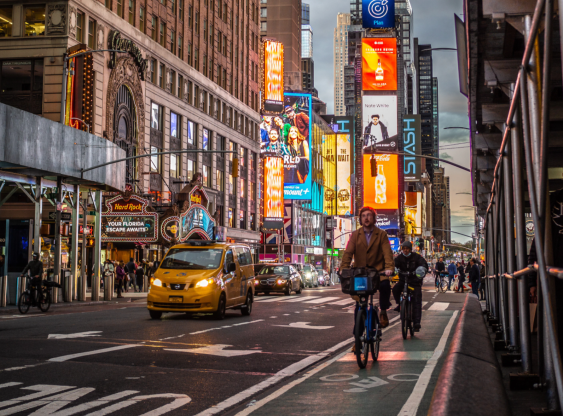
New York City has raised the bar in recent years for rolling out bicycle improvements and reclaiming public space from automobiles. While San Franciscans have come to expect major delays for bike projects as the norm in their city, New York, the only American city more dense than SF, has zoomed ahead by adding roughly 20 miles of protected bike lanes since 2007, with more on the way. After each new NYC bikeway is built, injuries to all users decline and bicycling increases along the corridor.
How can San Francisco emulate New York’s success? In short: San Francisco’s public officials need to exert bold leadership to hasten a painstakingly slow planning process intended not so much to achieve specific goals, but to avoid rocking the boat. That was the general sentiment at a recent forum where local bike advocates popped questions at Paul Steely White, the executive director of Transportation Alternatives, New York’s leading advocacy organization for bicycling, walking, and transit.
“New York’s success, tenaciousness, vision, and drive have been guiding the way for other American cities,” San Francisco Bicycle Coalition (SFBC) Executive Director Leah Shahum told an audience at the San Francisco Planning and Urban Research Association last Thursday, where she and White discussed the state of the bicycling movement in the two cities.
“We all know that we talk about Amsterdam, Copenhagen, Berlin, and Barcelona as being these wonderful bicycling cities, and many getting better and better, but [with] that European model, you really lose people,” said Shahum. ”To have a great American city guiding the way in being a great bicycling space, and really reclaiming space from the automobile and creating public space for people, frankly, is making our job a lot easier in San Francisco.”
NYC DOT Commissioner Janette Sadik-Khan has earned a reputation for pursuing groundbreaking projects like the two-way bikeway on Prospect Park West, which produced major benefits and, despite high-profile resistance from a small group of politically-connected NIMBYs, has been largely embraced by the public.
“We’ve been very lucky to have such great leadership that has managed, nevertheless, to involve communities and be very democratic while at the same time acting swiftly and decisively to implement safer streets,” said White. “I think one way to cut through the red tape, and maybe some of the needless process, is to appeal to safety, and say that every day that a street goes without pedestrian or bike infrastructure is putting people in danger.”
“There’s enough data now to show that it’s simply inhumane not to add bike lanes and pedestrian infrastructure when there’s an opportunity,” he added.
One of the main barriers preventing San Francisco from experiencing the same “impressive explosion” of visible change, said Shahum, is that SF transportation officials and politicians like Mayor Ed Lee haven’t been as willing to commit to completing bike projects, and that New York planners don’t have “to go through as much process as we do in San Francisco.”