Skip to content

Posts from the "Bus Rapid Transit" Category

8 Comments

Why Matier & Ross Got It Wrong in Their Jab at East Bay BRT

Cross-posted from Vibrant Bay Area, a new collaborative blog from urbanist writers around the Bay Area.

AC Transit’s proposed East Bay Bus Rapid Transit (BRT) line got a cheap kick in the gut yesterday from the Chronicle’s Matier & Ross. The duo took aim at the cost of BRT, a “jaw-dropping $18.7 million per mile,” but didn’t take a minute to compare the project to anything else in the Bay Area. BRT is a steal compared to other planned expansions, like BART to San Jose, but you wouldn’t know it by reading the Chronicle.

Image: AC Transit via Oakland Local

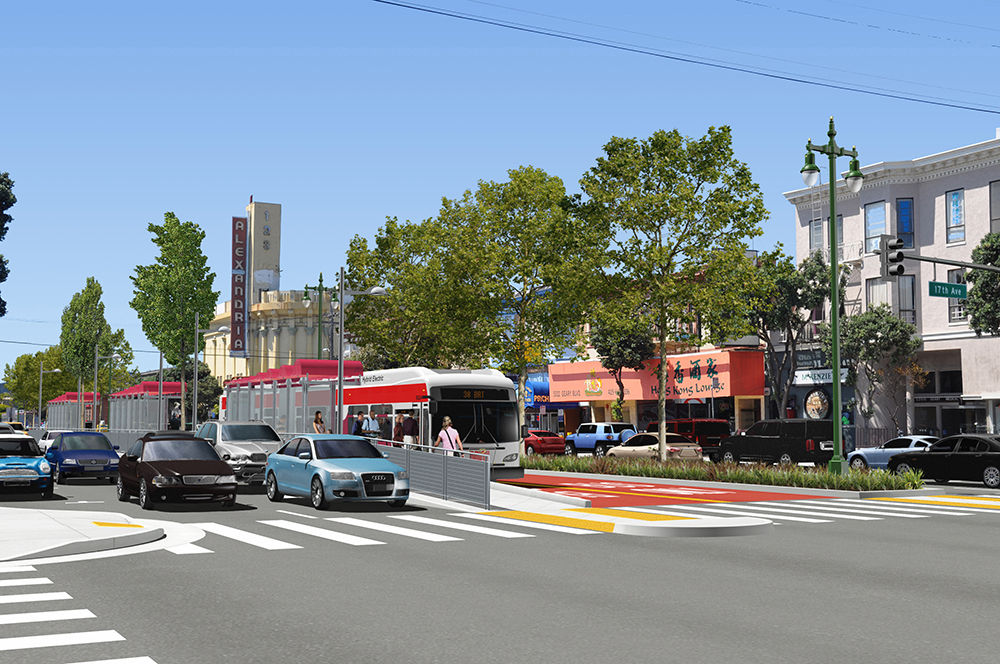
Bus rapid transit, or BRT, is a bus route separated from traffic using transit-only lanes with specialized boarding platforms. Where BRT is fully implemented, it functions like BART. Fares are paid before boarding and bus entrances are level with the platform. When a BRT line runs along city streets, they turn lights green as they approach intersections. Each of these measures speeds the bus service, making it more reliable and faster than regular, mixed-traffic buses.

AC Transit’s BRT line will cost about $178 million to run 9.5 miles along International Avenue in Oakland and San Leandro. Though the improvements won’t be as robust as what you’d find even in poorer countries like Colombia, there is still plenty of work to do. Planning, stations, new buses, signal infrastructure, medians, and other infrastructure will dramatically improve service along the corridor. In 20 years, it’s expected to attract 40,000 riders per day, 24,500 of whom will be new. For the number of riders AC Transit will attract, this is a long way from “jaw-droppingly” expensive.

The Greenbrae Interchange Project in Marin will cost $143 million and add capacity for 825 more car trips per day, or $173,000 each. BART’s extension to San Jose will cost at least $7 billion and serve, at most, 78,000 trips per day, or $90,000 each (though Eric at Transbay Blog thinks this is absurdly optimistic). At only $7,265 per new trip, East Bay BRT is far and away a cheaper, more cost-effective undertaking than nearly anything else under way in the region.

It’s a double shame, then, that businesses along the corridor have sought to dumb-down the project and strip it of features and length that will attract more riders. They fear a loss of parking and worse traffic, but by reducing the scope of the line they’ve cut off a vital link to customers. It has been shown again and again – San Francisco on Polk Street and Columbus Avenue; Utrecht [PDF]; Melbourne [PDF]; New York; Toronto [PDF]; and elsewhere - that the best customer base a business can have are those who walk, bike, or take transit.

The Chronicle would better serve the community by trying to inform rather than smear. The facts show that AC Transit’s plan is a coup for cost-effective transportation and will bring transit to a corridor that desperately needs better service. One would hope that a journalist (or two) would be interested in such things.

Streetsblog Chicago 19 Comments

Taking the Guesswork Out of Rating BRT: An Interview With Walter Hook

Rio+20 - June 19

Transoeste BRT in Rio de Janeiro. Photo by Michael Oko.

There’s a new global benchmark for rating bus rapid transit projects. Yesterday the Institute for Transportation and Development Policy released the BRT Standard 2013, which lays out the requirements for bus routes to qualify as BRT and scores 50 systems in 35 cities around the world as basic, bronze, silver, or gold based on various criteria. The idea, which ITDP has been refining since a beta release in 2011, is to provide a concrete definition of what BRT is, and a reference for politicians, planners, and advocates who are interested in creating new BRT routes, as well as to rate the quality of existing systems.

People Creating Change: Walter Hook

ITDP CEO Walter Hook. Photo by Colin Hughes.

The standard rates more than 30 aspects of bus corridor design, awarding points for elements that improve system performance. Dedicated bus lanes, level boarding, pre-paid boarding and signal prioritization are considered basic requirements for BRT. Additional elements that score points include multiple bus routes running on the same corridor; passing lanes at stations; low-emission buses; attractive, weather-protected stations; real-time arrival info signs; integration with bike sharing and more.

Streetsblog recently caught up with ITDP CEO Walter Hook via telephone to get more info on the new guide.

John Greenfield: Congratulations on releasing the BRT Standard. So this is kind of like the LEED [green building rating system] for bus rapid transit, correct?

Walter Hook: Yeah, that’s basically the idea, with the additional caveat that the BRT Standard is also positing a minimum definition for what constitutes BRT at all, which is not really an element in LEED. I mean, LEED doesn’t say, “You’re not a green building if you don’t hit any of these things.” The BRT Standard now has a minimum definition. That’s new from last time.

When the U.S. promoted BRT they didn’t promote it with a very clear definition. So a lot of mediocre bus improvements were implemented that tarnished the brand.

JG: What is your minimum standard for something to be called BRT?

WH: It’s a fairly complicated formula but essentially it has to have a dedicated lane of at least four kilometers. If it’s on a two-way road, it has to run along the central median. If it’s a curb-running bus lane on a two-way street it’s pretty much ineligible. So there are a couple of baseline things, but there are a lot of details and nuances.

Read more…

10 Comments

Geary BRT Advisor Resigns in Frustration at Snail’s Pace of SFCTA

Bus Rapid Transit on Geary Boulevard was originally slated to open last year. But today, planners are looking at a launch in 2020 — an eight-year setback for a project that was supposed to take advantage of low costs to get off the ground quickly.

For Kieran Farr, the cycle of delays, studies, and outreach campaigns by the SF County Transportation Authority was frustrating enough that he resigned from the Geary BRT Citizens Advisory Committee last month.

“I’m highly concerned that we’re doing this over and over again,” Farr told committee members and SFCTA staff at the most recent CAC meeting. “In the parlance of start-ups, which is the world where I come from, what this seems like is we’re having developers re-do the same product five different times without ever launching it to the public, and that’s really concerning.”

Farr said when he applied to join the CAC in 2008, he met with the project’s planners “to express my excitement about this project launching in 2012 which was the original planned start date because that [anniversary] coincides with when Muni was started in 1912 as a rail line, and that was the first municipalized line ever.”

Instead, Farr wrote on his blog, ”What I’ve seen in the past 6 years has been a severe disappointment during which I have lost trust in America’s regulatory framework to enact effective transit improvements.”

BRT on Geary has been discussed for at least a decade. The SFCTA completed the first step, a feasibility study, in 2007. Since then, planners have repeatedly revised the project and pushed the launch date back for reasons that baffle the public.

Merchants have opposed removing car parking for the project, and residents have complained about the project’s perceived potential to push car traffic on to parallel streets, putting pressure on planners to assuage the skeptics with more revisions and outreach. Many transit advocates have also urged the SFCTA to build a “rail-ready” project in hopes of someday replacing the 38-Geary, Muni’s busiest bus line (and one of the slowest), with light-rail service.

But as Farr noted, the whole idea of BRT is to provide quality bus service that rivals that of rail, using infrastructure that’s less expensive and easier to engineer, “with quick return on investment for the residents of San Francisco.”

Read more…

14 Comments

Oakland City Council Gives Final Approval to East Bay BRT

Image: AC Transit via TransForm

The Oakland City Council on Tuesday unanimously approved the 9.5-mile East Bay Bus Rapid Transit line that will run from downtown Oakland to San Leandro. The vote in Oakland follows a similar approval by San Leandro’s City Council on Monday.

The dual approvals mark a huge victory for advocacy groups and AC Transit, which first recommended BRT in 2001 as way to improve transit options on heavily traveled corridors. The East Bay BRT is expected to be completed in 2016 at a cost of between $152 million and $172 million, and will include seven miles of dedicated bus lanes in Oakland along International Boulevard with 33 stops, most located no more than one-third of a mile apart. Once finished, it will be one of the longest BRT routes in the country, and one of the few constructed in such a densely populated urban area.

“It’s tremendously significant,” said Joél Ramos, a community planner with TransForm. “It’s an indication of Oakland being a forward-thinking city… improving infrastructure to make travel, conducting business, accessing services, or even living along the corridor, more sustainable, more enjoyable, and more liveable.”

Before the vote, Tina Spencer, Oakland’s director of planning and service development, told the council: “The issue is slower transit, and it really creates an unsustainable condition. It’s a downward spiral. More congestion equals more delay, which contributes to unreliable service, fewer riders, which leads to less revenue, fewer riders and finally, service cuts.”

International Boulevard is one of the busiest and most important corridors in Oakland, with many homes and businesses, as well as near-by hospitals and medical centers, civic centers, shopping complexes and churches.

Read more…

14 Comments

Advocates Rebuff Merchant’s Absurd Argument Against East Bay BRT

Image: AC Transit

In an op-ed in the Oakland Tribune yesterday, local business owner Randy Reed laid down a whopping piece of misinformation: For businesses, he wrote, enhancing East Bay transportation options with Bus Rapid Transit will be no different than when construction removes all of the car parking on a street.

Reed, who led the charge in killing the Telegraph Avenue leg of the East Bay BRT route, got the piece published just as the project faces two critical hearings next week (see below for the schedule). Based on this new op-ed, Reed isn’t content to just squash transit improvements in his backyard — he also doesn’t want to let residents on the rest of the Downtown Oakland – San Leandro route reap the benefits.

Here’s what Reed calls the BRT “test run” that forms the backbone of his screed:

We have tested the effect of removing all street parking in our area, and it was devastating to our business. A test was run with city staff several years ago to see what happens with lane closures and parking removal on Telegraph from 43rd to 45th streets.

The problems were tracked: When the street was repaved; when ramps were installed on the corners; and when sidewalk repairs were performed.

Staff concluded that it would be disastrous.

Two local advocates offered up some fantastic rebuttals in the comments section. I’ll hand the mic over to Streetsblog’s own Oakland-based intern Robert Prinz, who is also the education coordinator for the East Bay Bicycle Coalition:

Maybe you would have a point if removing all street parking was actually part of the plan. Removing a few spots, sure, but the bulk of curbside parking spots will remain. The BRT planners I have talked to bent over backwards to keep as much parking as possible, to the detriment of other parts of the plan.

What is really going to happen is the reduced scope San Leandro-Oakland BRT is going to be built, it will be a huge boon for the communities along that corridor, and then the Telegraph merchants with a collective case of selective memory loss will start lining up to ask for an expensive extension into their business districts.

Read more…

28 Comments

Options for Geary BRT Come Into Focus

Geary and Fillmore, where the underpass could be filled in and "decked" to make the streets meet at the same grade again. Image: SFCTA (Renderings are conceptual only.)

Just after San Francisco approved a preferred design for its first Bus Rapid Transit route on Van Ness Avenue, the SF County Transportation Authority showcased the latest conceptual proposals for a companion BRT project on Geary Boulevard.

Geary BRT, which has been fraught with delays over the years, is expected to bring relief to riders on Muni’s notoriously sluggish 38-Geary line by significantly improving transit reliability and speeding up trips by as much as 30 percent.

The 38 follows Muni’s first streetcar route, traversing nearly the entire length of San Francisco from the Transbay Terminal to Ocean Beach. With 50,000 daily riders, it is the city’s busiest bus line. The BRT upgrade is expected to further boost ridership on the corridor, which carries as many travelers by bus as it does by car, according to SFCTA project leader Chester Fung.

“The buses don’t arrive when we’re expecting them to arrive, and they tend to bunch up when they get delayed by traffic,” said Fung. “Bottom line, we want to improve bus travel time and bus reliability.”

Geary BRT would speed up trips with features like dedicated bus lanes, off-board ticket machines, signal priority for transit, low-floor vehicles, and upgraded shelters. While all buses could potentially use the transit lanes, BRT buses would run as the 38-Limited and pass local buses in designated areas. Fung said planners are determining exactly which stops BRT will serve. The project will also include pedestrian safety improvements like sidewalk bulb-outs, and a number of left turns off of Geary may be banned.

These improvements have been a long time coming, with the project already delayed by four years. But SFCTA staff say they’ve learned some lessons from planning Van Ness BRT that should help them stay on track to meet their new target of completing the line in 2019.

Read more…

21 Comments

After Delay, SFCTA Board Approves Van Ness BRT Design

This post supported by

Image: SFCTA

A preferred design for Van Ness Bus Rapid Transit was approved unanimously today by the Board of Supervisors, acting as the SF County Transportation Authority Board. Supervisor Mark Farrell, who delayed approval of the proposal a month ago after complaining that he “hadn’t been briefed” on it, said he now stands behind the project after SFCTA staff brought him up to speed.

The project proposal received broad praise from the board and transit advocates as an “elegant solution” to combine the best features of two design options.

“This project is an example of what is critical to the future of transportation in the city,” said Supervisor Scott Wiener. “We have a growing population… and if we don’t start beefing up our transit capacity, we’re going to have a big problem.”

SFCTA Executive Director José Luis Moscovitch pointed out that the project, along with Geary BRT, will go a long way toward reducing car trips as new development arrives along the Van Ness corridor — namely, California Pacific Medical Center’s Cathedral Hill project at Van Ness and Geary.

Brett Thomas of the SF Transit Riders Union emphasized the need to physically separate the bus lanes from car traffic to keep drivers from encroaching on them and delaying transit. Wiener echoed the sentiment, citing his experience on the J-Church this morning, in which “a delivery truck was parked a little too far from the curb, and literally shut down the entire J-Church inbound line.”

Read more…

19 Comments

Supervisor Farrell Delays SFCTA Approval of Van Ness BRT Design

A crucial step in advancing the Van Ness Bus Rapid Transit project was delayed for a month today after Supervisor Mark Farrell, a member of the SF County Transportation Authority (SFCTA) Plans and Programs Committee, complained that he wasn’t comfortable voting on the latest design proposal which he said he “hasn’t been briefed on.”

Supervisor Mark Farrell. Photo: Jennifer Low/Flickr

The committee was expected to approve recommendation of the proposal today, sending it to the full board for a vote next Tuesday. However, Farrell said that it was “absolutely inappropriate” for him vote on it today without feeling adequately informed, and that he still wouldn’t be ready in a week. Although the proposal received unanimous approval from the SFMTA Board of Directors today, the SFCTA committee decided to postpone its vote until its next meeting, in one month.

Staying updated on the project, said Farrell, “is a responsibility of mine, for sure, but it’s also a responsibility of the TA [staff].”

“In my opinion, it is very appropriate and, I think, necessary for all the supervisors and commissioners who get affected by this in their districts to be fully briefed on this before we’re asked to vote on any portion of this, even if it might be non-binding,” he said.

Read more…

7 Comments

East Bay BRT EIR Approved, Final Agreements Set for June

This post supported by

Image via TransForm

Bus rapid transit (BRT) between Oakland and San Leandro in the East Bay cleared a major hurdle this week after AC Transit unanimously approved the project’s environmental impact report. Agreements with the cities of Oakland and San Leandro must still be finalized in June before the project can officially break ground.

“This plan represents a big step in making bus service significantly better in the East Bay,” said Marta Lindsey, communications director for TransForm. “But it’s also a big step for the entire Bay Area, as it will showcase what’s possible: faster, more reliable, and more frequent buses – plus a better experience for riders all-around and at an incredible value.”

Marta noted that East Bay BRT has the highest cost-efficiency rating from the Federal Transit Administration of any public transportation project in the nation currently competing for federal funds.

The full Oakland-to-Berkeley corridor won’t get true BRT after merchants in Berkeley complained about losing car parking to dedicated bus lanes. But this section will bring substantial benefits on its own: 22 community organizations have signed a letter [PDF] cheering the estimated 39 percent improvement in travel times, 300+ jobs, and transit-oriented growth the project is expected to bring along the International Boulevard corridor.

10 Comments

Mapping a Fully Transit-Connected Bay Area

Brian Stokle's map envisions how the Bay Area region could possibly be connected by future transit projects -- some planned, some only envisioned -- including high-speed rail, BART extensions, and BRT lines. Image via The Atlantic Cities

Imagine the freedom of being able to hop on a nearby train or bus to reach virtually any place in the Bay Area (and beyond) on an integrated network of reliable transit.

That’s the vision cartographer Brian Stokle sought to lay out in a map featured in the latest issue of SPUR‘s monthly magazine, The Urbanist. In a recent article in The Atlantic Cities, Urbanist editor Allison Arieff says that the map, along with another map of existing regional transit that Stokle created, “have generated a lot of conversation (and some controversy) — which is exactly what they were meant to do”:

The majority of the projects, routes, and modes shown in Stokle’s proposed “Future” map (or some might argue, “Utopian”) reflect current Bay Area planning. However in some cases, the mode or route has been changed. In other instances, some new routes have been suggested. For example, BART to Livermore and Dumbarton Rail are two projects that are not included in this map. Instead, access to Livermore from BART is provided by bus rapid transit, and the Dumbarton corridor is served by rapid bus service. New projects that are not currently part of planning, or are in their early phases include projects like the Oakland Emeryville streetcar down Broadway, Capitol Corridor crossing at Vallejo, and 101 Rapid in the Peninsula.

Some ideas are old, some more novel. In San Francisco, the controversial Central Subway (now under construction) is shown extending all the way to Lombard and Van Ness to meet the coming BRT line, which is also extended to connect the Transbay Terminal to Marin County via the Golden Gate Bridge (where a BART line was fought off in the 60′s).

What would it take to bring a comprehensive vision like this into reality, and which projects could be feasibly built? Regional planners are currently figuring that out as they develop the Bay Area’s 25-year Sustainable Communities Strategy and Regional Transportation Plan. Next month, staff from the Metropolitan Transportation Commission, the Bay Area’s transportation financing agency, will present a list of the transit projects they determine to be the most beneficial and cost-effective to build in the coming years. Stay tuned to Streetsblog for more on that.

In the meantime, check out Stokle’s map of the existing regional transit network — one of SPUR’s ideas for saving transit – after the break.

Read more…