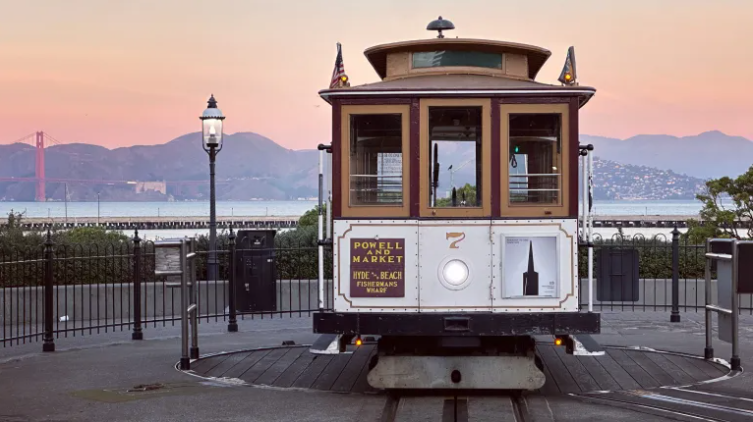
Cable cars are icons of San Francisco, a draw of tourist dollars far beyond their fare revenue, and living pieces of San Francisco history and transit. They're also protected in the
city's charter, just like the Transit First policy, though perhaps with greater force. Like the Golden Gate Bridge, cable cars bring visitors to the city, where they spend their money at hotels, restaurants, museums, bars, and other attractions. But while their overall economic value to the city undoubtedly exceeds their operating cost to Muni, their fare revenue does not. And unlike the Golden Gate Bridge, cable cars do not ultimately provide a vital transportation link for residents and commuters.
Angela Jackson, a spokesperson for the San Francisco Convention and Visitors Bureau, wouldn't put an exact dollar figure on cable cars' value to local tourism, an industry that brought in about $8.5 billion to San Francisco last year. But they're certainly one of the top draws, she said. "The cable cars for San Francisco are invaluable as far as tourism goes. Cable cars are one of the must-experience attractions for everyone who comes to San Francisco."
"I used to work for one of the hotels that was on one of the cable car lines, and we would get calls once a week from some production company wanting to stage photo shoots because it stopped in front of our hotel. I don't think there's anything that depicts San Francisco, whether it be a feature article in a magazine or in a newspaper, or a travel series that does not include the cable car."
Cable cars are routinely packed, in spite of frequent service and a five-dollar one-way fare for those without a Fast Pass. As a result, cable cars recover roughly half their operating cost through fare revenue, about $24 million in fiscal year 2008, an impressive feat given that they are by far the most expensive mode to operate in the Muni system. In fiscal year 2008, that still left $27 million that the MTA had to subsidize from its general operating funds, a significant sum considering Muni's $129 million deficit this year. Getting rid of cable cars would be killing the golden goose, not to mention a historical atrocity and a violation of the city charter, but could there be a source of funding that more directly harnesses cable cars' contribution to citywide tourism revenue?
Read more...