Skip to content

Posts from the "Geary BRT" Category

12 Comments

New CPMC Hospital Deal: Smaller Campus, But More Car Parking for Its Size

The new plan for California Pacific Medical Center’s Cathedral Hill campus at Van Ness Avenue and Geary Boulevard calls for a far less massive facility than originally planned, but the number of car parking spaces per bed will actually be higher.

A rendering of CPMC's originally proposed 555-bed Cathedral Hill campus at Van Ness and Geary.

Under the new agreement announced by city supervisors yesterday, the size of the hospital will be cut nearly in half, from 555 beds to 304 beds. But the number of parking spaces included in its garage won’t be downsized at the same ratio, shedding only 210 of its 1,200 original spaces — a 20 percent reduction, according to the SF Examiner. So while the facility may bring in less car traffic as a whole, it will actually be more car-centric compared to the original plan.

“There’ll be a lesser impact on transit from traffic, but it’s only because they made the hospital smaller, not because they got any smarter about transportation,” said Livable City Executive Director Tom Radulovich.

Of the location at Van Ness and Geary, Radulovich says, “If you were going to pick a spot that’s not on Market Street where you could do the most damage to transit, Van Ness and Geary is pretty much it.”

The $14 million that CPMC has agreed to pay the SF Municipal Transportation Agency to help fund Van Ness and Geary Bus Rapid Transit projects was also reduced from the $20 million included in the development agreement as late as November, according to the Chronicle (though it’s still more than the $10 million Mayor Ed Lee originally asked for in 2011).

Read more…

10 Comments

Geary BRT Advisor Resigns in Frustration at Snail’s Pace of SFCTA

Bus Rapid Transit on Geary Boulevard was originally slated to open last year. But today, planners are looking at a launch in 2020 — an eight-year setback for a project that was supposed to take advantage of low costs to get off the ground quickly.

For Kieran Farr, the cycle of delays, studies, and outreach campaigns by the SF County Transportation Authority was frustrating enough that he resigned from the Geary BRT Citizens Advisory Committee last month.

“I’m highly concerned that we’re doing this over and over again,” Farr told committee members and SFCTA staff at the most recent CAC meeting. “In the parlance of start-ups, which is the world where I come from, what this seems like is we’re having developers re-do the same product five different times without ever launching it to the public, and that’s really concerning.”

Farr said when he applied to join the CAC in 2008, he met with the project’s planners “to express my excitement about this project launching in 2012 which was the original planned start date because that [anniversary] coincides with when Muni was started in 1912 as a rail line, and that was the first municipalized line ever.”

Instead, Farr wrote on his blog, ”What I’ve seen in the past 6 years has been a severe disappointment during which I have lost trust in America’s regulatory framework to enact effective transit improvements.”

BRT on Geary has been discussed for at least a decade. The SFCTA completed the first step, a feasibility study, in 2007. Since then, planners have repeatedly revised the project and pushed the launch date back for reasons that baffle the public.

Merchants have opposed removing car parking for the project, and residents have complained about the project’s perceived potential to push car traffic on to parallel streets, putting pressure on planners to assuage the skeptics with more revisions and outreach. Many transit advocates have also urged the SFCTA to build a “rail-ready” project in hopes of someday replacing the 38-Geary, Muni’s busiest bus line (and one of the slowest), with light-rail service.

But as Farr noted, the whole idea of BRT is to provide quality bus service that rivals that of rail, using infrastructure that’s less expensive and easier to engineer, “with quick return on investment for the residents of San Francisco.”

Read more…

28 Comments

Options for Geary BRT Come Into Focus

Geary and Fillmore, where the underpass could be filled in and "decked" to make the streets meet at the same grade again. Image: SFCTA (Renderings are conceptual only.)

Just after San Francisco approved a preferred design for its first Bus Rapid Transit route on Van Ness Avenue, the SF County Transportation Authority showcased the latest conceptual proposals for a companion BRT project on Geary Boulevard.

Geary BRT, which has been fraught with delays over the years, is expected to bring relief to riders on Muni’s notoriously sluggish 38-Geary line by significantly improving transit reliability and speeding up trips by as much as 30 percent.

The 38 follows Muni’s first streetcar route, traversing nearly the entire length of San Francisco from the Transbay Terminal to Ocean Beach. With 50,000 daily riders, it is the city’s busiest bus line. The BRT upgrade is expected to further boost ridership on the corridor, which carries as many travelers by bus as it does by car, according to SFCTA project leader Chester Fung.

“The buses don’t arrive when we’re expecting them to arrive, and they tend to bunch up when they get delayed by traffic,” said Fung. “Bottom line, we want to improve bus travel time and bus reliability.”

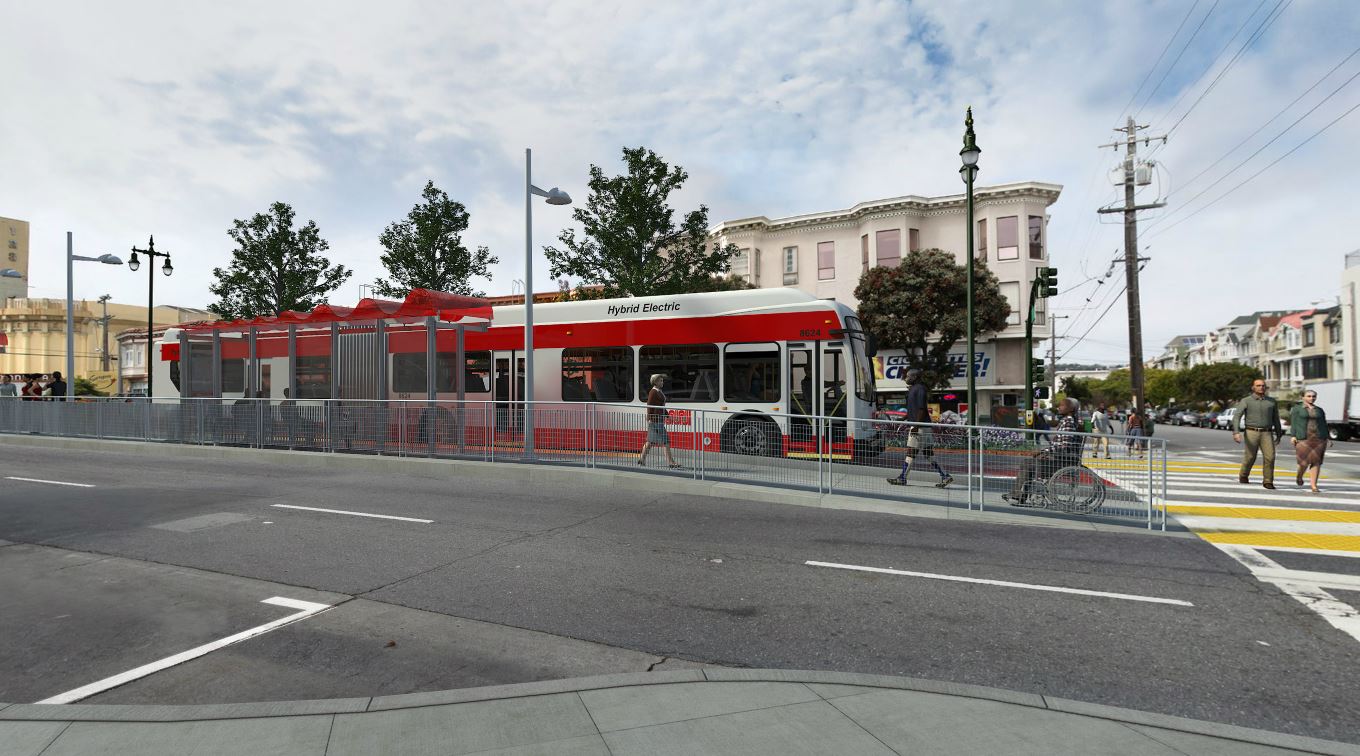
Geary BRT would speed up trips with features like dedicated bus lanes, off-board ticket machines, signal priority for transit, low-floor vehicles, and upgraded shelters. While all buses could potentially use the transit lanes, BRT buses would run as the 38-Limited and pass local buses in designated areas. Fung said planners are determining exactly which stops BRT will serve. The project will also include pedestrian safety improvements like sidewalk bulb-outs, and a number of left turns off of Geary may be banned.

These improvements have been a long time coming, with the project already delayed by four years. But SFCTA staff say they’ve learned some lessons from planning Van Ness BRT that should help them stay on track to meet their new target of completing the line in 2019.

Read more…

22 Comments

City Hall Hearing Turns Spotlight on Problems Plaguing 14-Mission Line

The thousands of daily Muni riders who take the 14-Mission line continue to endure frequent switchbacks, poor reliability, slow speeds, and overcrowding, but advocates and city leaders are putting a spotlight on the problems plaguing the busy Mission bus corridor, which serves one of San Francisco’s most transit-dependent communities.

“It’s the only one of the top three busiest [bus] lines without a plan to speed it up,” said Fred Sherburn-Zimmer, an organizer of the San Francisco Transit Rider Union’s (SFTRU) 14-Mission Task Force. ”Why isn’t this major corridor for working class people in the city a priority? It’s busy no matter what, eleven at night, seven in the morning, and it doesn’t matter which stop you’re getting off at.”

A hearing called by Supervisor John Avalos at today’s San Francisco County Transportation Authority Plans and Programs Committee meeting sought to address the switchbacks on the line following complaints from riders. SFMTA Director of Transit John Haley explained in a presentation [pdf] that Muni management orders switchbacks to alleviate delays. They force riders off a vehicle, mostly in the outbound direction, in order to serve points on a line that have a greater ridership demand.

“When one of the lines is substantially behind schedule, it’s one of the things that’s available to us so that we balance the line in both directions,” said Haley. “All five of the rail lines go through the subway, it has to be managed as a system. If something happens on one line, it can impact all the other lines.”

Read more…

24 Comments

SFBC Presses for Bike Access on a Piece of Geary Boulevard

geary_at_beaumont.JPGThe relatively gentle grades of Geary Blvd. approaching Masonic make it the route of choice for most bicyclists in the corridor.
The SFBC is working with the Transportation Authority (TA) to get a bicycle path considered for a portion of the Geary BRT project, a result of a meeting held between the two groups recently.

Livable streets advocates around the country are often surprised to hear that such a large capital project does not already include bike lanes. "If you're going to spend more than $200 million, how can you not squeeze bike lanes in," goes the refrain. But the impact of capturing an additional ten feet from the 90-foot right-of-way is significant. Something has to give: a lane of parking, a pedestrian refuge, a transit passing lane, or one of the two remaining travel lanes.

None of these are attractive options for a project that is already getting political pushback for its relatively minor traffic and parking impacts, nor is it an attractive option to spend nearly $250 million on a project and not do anything to improve bicycle safety on Geary. Volunteers, including me and staff of the Bicycle Coalition, have been trying to resolve this conundrum since the inception of the project.

The SFBC has asked the TA to focus on the segment of the Geary BRT project between Arguello and Webster Streets. West of Arguello, Anza is a good alternative to Geary for most bike trips, while between Arguello and Presidio, there is no parallel route. The SFBC requested the TA to look at bike access as far east as Webster in order to connect a Geary facility with the Webster Street bike lanes.

Read more...