Advocates Question Public Benefit of Caldecott Tunnel Fourth Bore
 Photo: pbo31
California Governor Arnold Schwarzenegger announced bids for the fourth bore of the Caldecott Tunnel earlier this week, claiming that the new $420 million tunnel on State Route 24 through the Oakland hills will reduce congestion for the 160,000 motorists who use it daily and that it will create 6,000 new jobs.
"This project will reduce local traffic congestion while creating nearly 6,000 jobs for California – and is a solid investment in the future of the Bay Area’s transportation infrastructure," Schwarzenegger said in a statement.
Of the estimated $420 million needed to complete the job, $11 million would come from the Proposition 1B transportation bond passed in 2006, as well as $197.7 million the state secured through the American Recovery and Reinvestment
Act (ARRA). The balance for the project would be made up of local and regional funding.
The governor adopted the fourth bore project as part of his push to
pass Prop 1B and at the time threatened to
exempt the project from environmental review after a coalition of bicycle, pedestrian, and public transit advocates
sued Caltrans for preparing an inadequate EIS. The exemption would have effectively nullified the lawsuit, so advocates settled with Caltrans last January, in the process securing nearly $6 million for bicycle and pedestrian improvements throughout the East Bay.
The settlement also added protections for construction impacts by requiring low -sulfur fuels to reduce emissions from construction vehicles, reduced light pollution from construction activities, and reduced noise impacts on nearby residents, according to East Bay Bicycle Coalition Executive Director Robert Raburn, one of the coalition of litigants that sued Caltrans.
Raburn claimed the project benefits motorists over transit riders
and argued that the money spent on this project should have gone to increasing transit capacity or adding another tube for BART under the bay.
"The only benefit of this project is for the reverse commute," said
Raburn. "The Contra Costa resident that wants to get to the San Francisco Opera in
a hurry will be able to blast right through."
 Image: Caltrans
Raburn contends the new tunnel will not provide additional throughput in the peak direction, despite the implication made by Schwarzenegger that it will alleviate congestion. Caltrans workers currently maintain one of the three tunnels open in each direction throughout the day, then direct cars through the middle tunnel based on which direction sees more traffic.
A spokesperson for Caltrans, Jeff Weiss, confirmed that the new tunnel will not add capacity in the peak direction, but will make non-peak traffic flow better, which is a priority for Caltrans.
"The non-peak direction has gotten to be more and more of a problem, particularly on the weekend. [Caltrans workers] have changed the middle bore up to 13 times on the weekend," said Weiss, describing a scenario where a Cal football game brings a great deal of traffic on a Saturday morning, followed by a concert at Oakland's Oracle Arena, requiring Caltrans to spend man hours altering the middle bore traffic flow.
Weiss also confirmed that the figure of 6,000 additional jobs created came from US DOT figures that estimate highway projects generate approximately 18,000 for every $1 billion spent.
Raburn, who reluctantly admitted that "the ship has sailed on this project," still noted that the big loser will be BART riders:
There will be fewer people who pull off and ride BART. It's going to degrade BART's ridership, siphon off passengers who currently find BART to be a more convenient option. They need those passengers throughout the day, [especially] in the off-peak direction. That's money that goes right into BART's pocket and justifies their existence and enables them to fund more trains.
Stay in touch
Sign up for our free newsletter
More from Streetsblog San Francisco
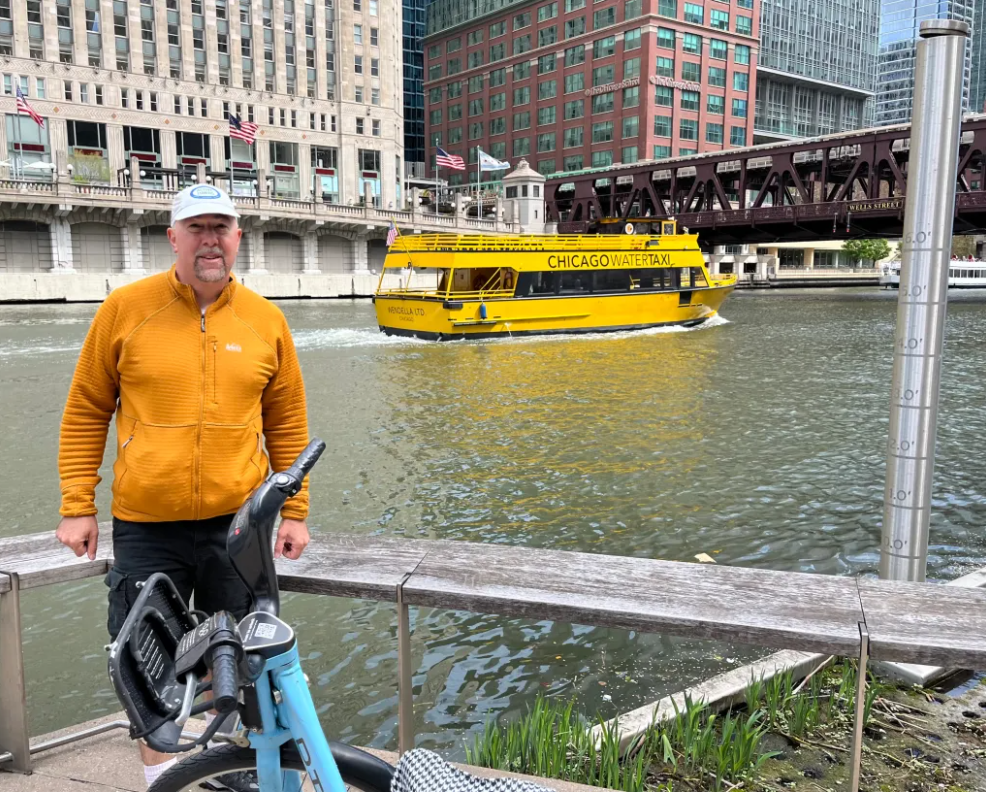
Streetsblog SF editor Roger Rudick offers constructive criticism of Chicago’s downtown bike network
"There were blocks that felt very safe and very secure," he said. "But then you're immediately – voom! – disgorged into three lanes of moving traffic with no protection."
Commentary: There is Zero Ambiguity to the West Portal Tragedy
What happened in West Portal was entirely predictable and preventable. The city must now close Ulloa to through traffic and make sure it can never happen again