New Stats on the Health and Business Benefits of Sunday Streets

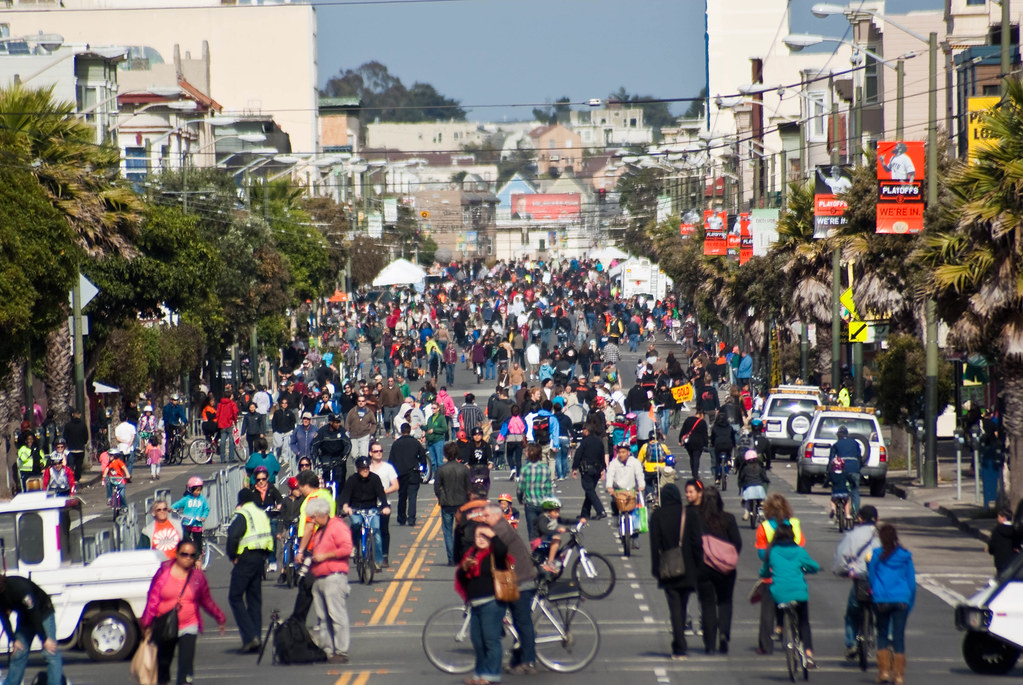
When San Francisco streets are opened up to people for Sunday Streets, the influx of foot traffic brings a host of health and economic benefits to the city’s neighborhoods, according to findings presented by Dr. Susan Zieff, a professor of kinesiology at SF State University, at a Board of Supervisors committee hearing yesterday.
Zieff and her team surveyed 600 Sunday Streets participants at events 2010 and 2011, collecting data that makes a strong case for investing in open streets events. One of the data points we reported in late 2011, for instance, is that every dollar spent on running Sunday Streets yields an estimated savings of $2.32 in medical costs.
The studies “have been really invaluable to us,” said Tom Radulovich, executive director of Livable City, which organizes Sunday Streets with help from city agencies.
The top reason people come to Sunday Streets, said Zieff, is to enjoy the city’s streets in a way that’s impossible at nearly any other time, when the space is primarily reserved for traffic and parking.
“Over and over again, people talk about being able to walk down the middle of the street with their families, do physical activity in a safe environment, not to worry about vehicle traffic, and generally be around people who are having a good time,” said Zieff.
In Zieff’s survey, 51 percent of participants reported coming from outside the neighborhood, and the average participant traveled 3.25 miles, round trip, to the event. Among those who had attended Sunday Streets more than once, 25 percent reported an overall increase in physical activity since they began participating in the events. And, Zieff noted, the ethnic demographics at Sunday Streets are generally representative of the city as a whole, meaning the events appear to be effective at increasing physical activity among African-American and Latino residents, who tend to suffer the highest rates of cardiovascular disease.
The data “affirms what we understood anecdotally,” said Radulovich. “Sunday Streets is getting San Franciscans to walk, cycle, and exercise more, and integrate active transportation into their everyday lives. It has also been successful in reaching San Franciscans of all ages and backgrounds.”
During each event, 44 percent of businesses report an increase in customer activity and sales, with an average increase of $466 in net revenue along each route, said Zieff. As Sunday Streets organizers have reported, merchants who initially resisted Sunday Streets for fear of losing business are now clamoring for the events to come to their neighborhoods.
“We know there was some merchant concern about loss in business,” siad Zieff. “We actually show the opposite.”
Although restaurants have reported an overall decrease in walk-in customers on event days, shops and other types of businesses generally see an increase. Merchants that hold outdoor activities to engage with participants at the events — just under 20 percent of those surveyed — reported an average jump in business of two-thirds.
The influx in business also means more available work, as one in five businesses report increasing their staffing for the event, said Zieff. A total of 70 extra employees, on average, were scheduled to work at businesses along Sunday Streets routes compared to regular Sundays. That means “more employees, more salaries, more income to spend and so forth across the city,” said Zieff.
At the most recent Sunday Streets event, held in the Dogpatch and Bayview neighborhoods last weekend, a number of restaurants on Third Street that are normally closed on Sundays remained opened for business, said Rebecca Gallegos, manager of public relations and fundraising for the Bayview Opera House.
Organizers purposefully avoid allowing outside vendors at Sunday Streets in order to encourage attendees to visit local businesses, said Radulovich. “We actually want people to shop in the neighborhood.”
Even after a Sunday Streets event is over and streets are once again the dominion of cars, Zieff noted that there are lasting benefits that aren’t as easy for researchers to measure, such as the increased sense of community, and the effect of discovering a new neighborhood.
“One piece that’s really difficult to measure here,” she said, “is those 25,000 people who walk by stores in the Mission and notice a store for the first time, and make a note to return to that store.”

Read More:
Streetsblog has migrated to a new comment system. New commenters can register directly in the comments section of any article. Returning commenters: your previous comments and display name have been preserved, but you'll need to reclaim your account by clicking "Forgot your password?" on the sign-in form, entering your email, and following the verification link to set a new password — this is required because passwords could not be carried over during the migration. For questions, contact tips@streetsblog.org.