Eyes on the Street: San Jose Tests Out a Two-Way Protected Bikeway

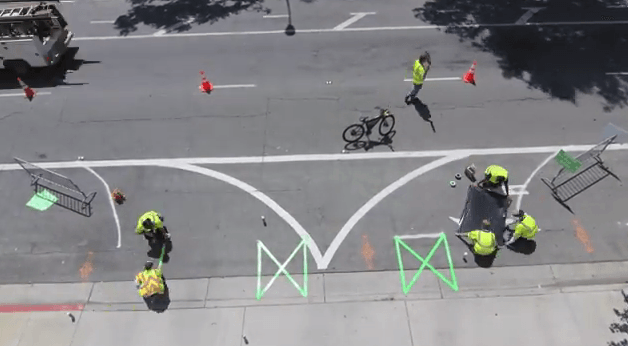
Last week the city of San Jose created a “pop-up” to show what a protected bikeway can do, and to gather people’s reactions to various potential designs.
It was part of a week-long training on “Better Bikeways” brought to San Jose by the National Association of City Transportation Officials (NACTO). The training included a workshop on designing better bikeways for San Jose city staff, a bike leadership session for civic leaders, and a technical meeting of the NACTO Cities for Cycling group, of which San Jose is a member.
Attendees also took in the Silicon Valley Bicycle Coalition Bike Summit, which happened on Tuesday.
The pop-up protected bikeway was an opportunity to demonstrate potential designs for safe, comfortable bike lanes that are separated from traffic. It was placed along five blocks of Fourth Street, which is a busy one-way street that connects City Hall and San Jose State University and feeds onto the 280 freeway.
A pilot protected bikeway was already in place along part of the route. That one is a very short, parking-protected bikeway that passes SJSU and is used as a contraflow lane—that is, bike riders use it to ride against traffic—even though that’s not why it was built and it is not an officially sanctioned use.

The pop-up took that part of the lane, which is very wide, and made it a two-way protected bike lane. It also extended it further into downtown and made that part an official contraflow lane, allowing bikes to continue against traffic there. Different materials were used to “protect” the bike lane, including potted trees, wooden planters, swoopy plastic waves, and orange cones.

The long-term goal is a connected series of protected bikeways to make it safe for more people to ride bikes through downtown, across major barriers like freeways, and to and from trails.
Colin Heyne, Deputy Director of the Silicon Valley Bicycle Coalition, attended one of the NACTO workshops and liked what he saw and heard. A representative from Chicago talked about that city’s decision to find space for protected bikeways even though its downtown grid is pretty tight. “Their protected bikeways are not ideal—I think some of them are only four feet wide,” he said. “But they are fully protected from traffic.”
And the results, in the last four or five years of putting them in, he said, has been a significant increase in cycling and safety in that city.

What Heyne appreciated, and was glad to have San Jose staffers hear, was that Chicago just forged ahead and found a way to build the lanes. “There are a thousand excuses for not being able to do this stuff,” he said. “And to hear from another big city that they worked around the problems–I think that was good for our engineers to hear.” He saw the NACTO workshop as a little bit of a push for San Jose to see the city can be proactive about better, safer infrastructure.
“We have these goals—San Jose has a bike mode share goal of fifteen percent—but without making some of these sacrifices and some of these compromises, we’re never going to get there,” he said.
The demo bikeway stayed up the entire week. Heyne and the bicycle coalition led a bike tour on Friday during rush hour to get people to try it out and hear their reactions. About thirty people showed up to check it out.


Read More:
Streetsblog has migrated to a new comment system. New commenters can register directly in the comments section of any article. Returning commenters: your previous comments and display name have been preserved, but you'll need to reclaim your account by clicking "Forgot your password?" on the sign-in form, entering your email, and following the verification link to set a new password — this is required because passwords could not be carried over during the migration. For questions, contact tips@streetsblog.org.