Advocates Start “Bikes on Board” Campaign for Muni Rail

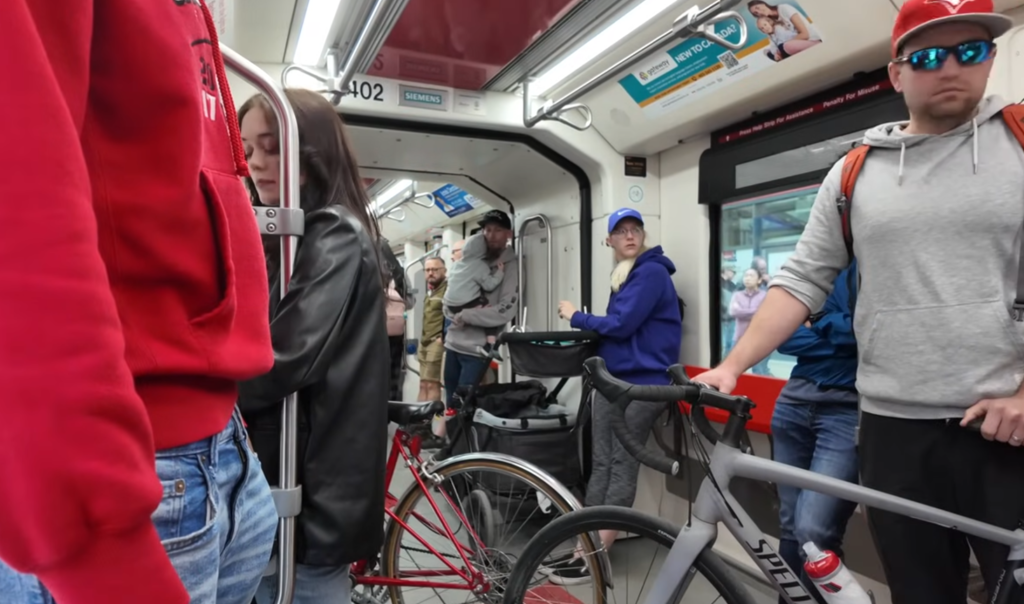
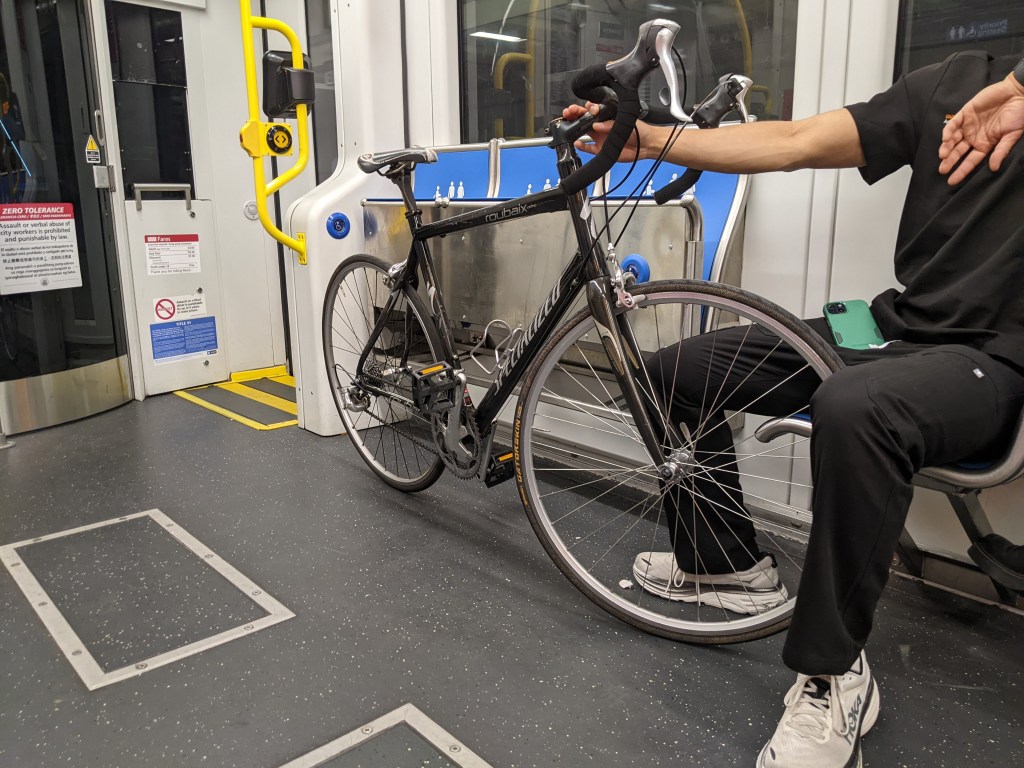
The lead image is from rush hour, with cyclists sharing space with other commuters on one of Muni’s S-200 light rail vehicles, built in the Siemens facility in Sacramento. Okay, one part of that is inaccurate: the S-200 in the image isn’t owned by Muni. It’s the CTrain in Calgary, Alberta, Canada.
But other than that, it’s the same train car bodies and dimensions. Calgary Transit carries 152,700 people per weekday on its trains, making it one of the busiest LRT systems in North America. It welcomes bikes. Muni carries 126,000. It bans them.
“I know there are real considerations regarding capacity and space,” said District 3 Supervisor Danny Sauter. “But I strongly feel we should pilot a new policy that allows bikes on certain lines or at certain times of day.”
As Streetsblog pointed out in a recent short video, every rail transit system in North America allows bikes on board. Only two have restrictions on light rail vehicles.
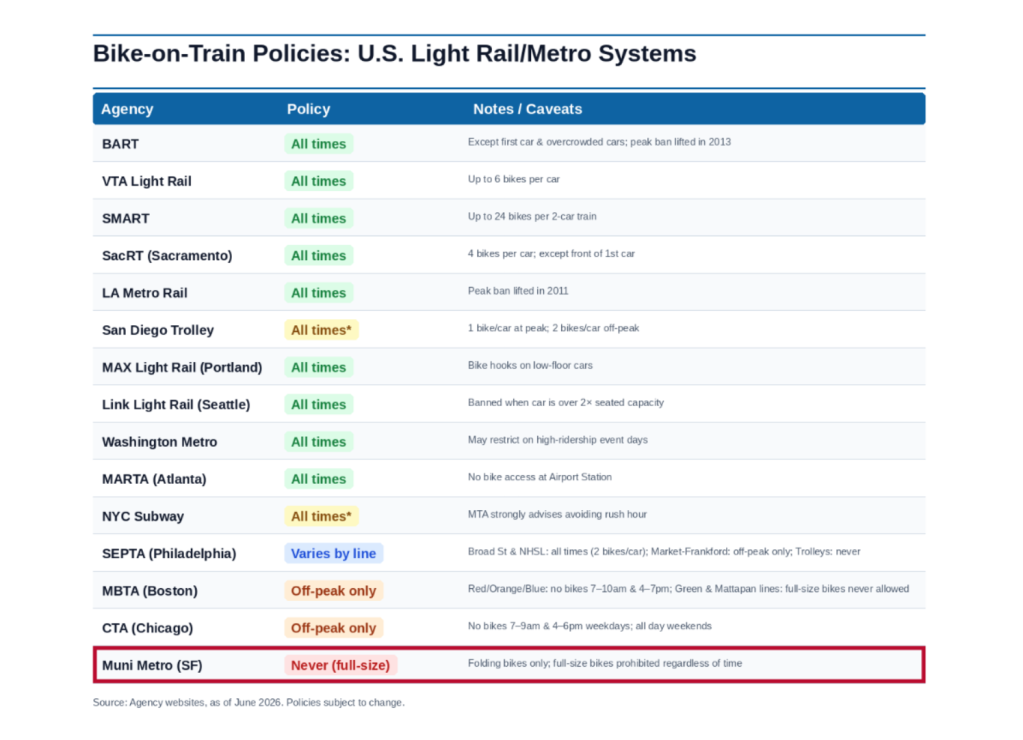
All of which is why advocate Bruce Halperin has started a “Bike on Muni Metro” member-led project with the San Francisco Transit Riders to change Muni’s blanket bike ban.
From Halperin’s project page:
This policy has long prevented people riding bikes from accessing large portions of the city, especially on the Westside and Bayview, and is long overdue for reconsideration. Balboa Park, the Sunset District, West Portal, Bayview, and surrounding neighborhoods would be much more accessible if bicycles were available as a first-/last-mile option for riders of the J, K, L, M, N, and T lines. These neighborhoods are underserved by Bay Wheels stations and bikes, so those are not currently a viable option for most riders.
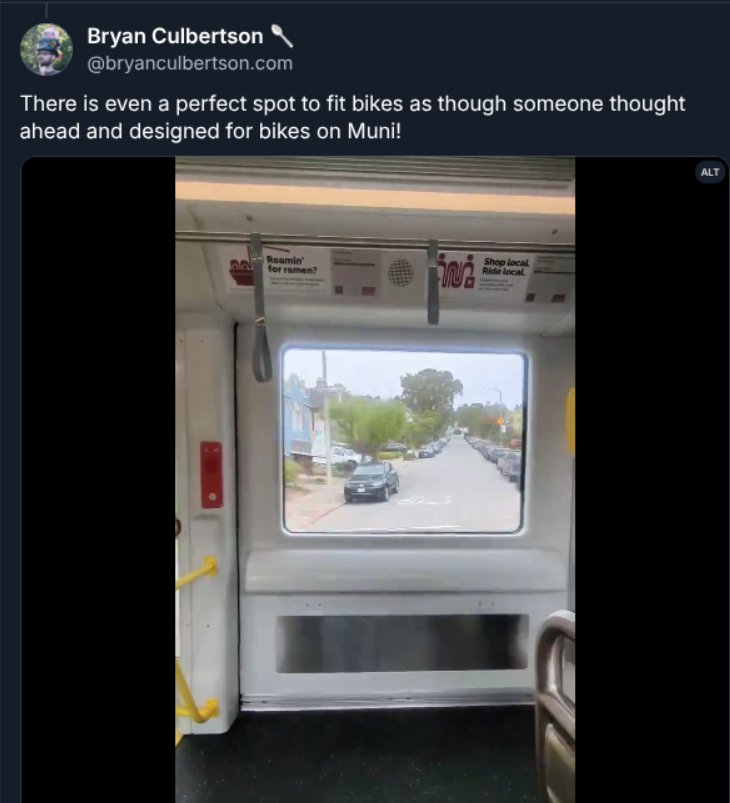
Prior to the pandemic, the rationale for banning bikes was crowding on Muni’s downtown platforms and trains. However, the pandemic ushered in significant changes to San Franciscans’ commute patterns, most notably by enabling work-from-home for large numbers of residents who formerly worked in offices downtown. Despite return-to-office mandates, Muni’s LRV lines remain substantially under capacity. This means additional space for bikes where there may not have been before the pandemic. Muni has also since phased out all of its LRV2 and LRV3 cars, and all LRV4 cars have space near the doors that is perfectly sized for most bicycles. Allowing people to board with bikes would help increase Muni ridership, which is badly needed at a time when Muni faces potentially devastating budget cuts.
“We’re searching for ways to get in contact with SFMTA planners to learn more about why bikes aren’t allowed on Muni Metro and exploring ways riders can let the agency know there’s a demand,” explained the San Francisco Transit Riders’ Reanne Lacosta.
“The San Francisco Bicycle Coalition fully supports bikes on Muni light rail,” said Claire Amable, SFBike’s Director of Advocacy.
“Allowing bikes on Muni trains—perhaps through a pilot limited to certain lines, days, and/or hours—is a worthwhile experiment to gauge demand, highlight benefits, and identify any issues,” said Streets Forward’s Luke Bornheimer.
The Mayor’s press office, meanwhile, declined to address the issue and referred questions to SFMTA.
So what is SFMTA’s official reason?
As Halperin pointed out, Muni trains used to be overcrowded and sometimes didn’t have space for bikes (or anything else). That was never true off-peak, of course, and it’s doubly untrue since the pandemic. The simple fact is Muni officials have given constantly changing rationales. SFMTA Director Julie Kirschbaum once told Streetsblog it was because of the stairs. But lots of rail systems that allow bikes have stairs, including Amtrak and Caltrain. And if Muni’s movable stairs are really dangerous for people holding bicycles, isn’t the same true of anyone holding a suitcase or a shopping cart or a folding bike (which is allowed)? How about for someone in a wheelchair or using a cane? If the stairs are too dangerous for cyclists, they’re too dangerous for everyone; maybe the answer is to build high-level platforms everywhere, not single out one group of riders.

Moreover, if that’s really the issue (and it isn’t), why not allow bikes on the T Third, which never lowers its stairs? Why not just ban bikes west of West Portal, since trains on the L, M, and K don’t lower their stairs until that point. Or Muni could only allow bikes to alight at wheel-chair accessible stations with platforms and ramps. It’s really not that challenging, if the agency is interested in doing this.
Meanwhile, the CTrain in Calgary previously only allowed bikes during off-peak times. In 2022, they changed the rules and piloted allowing bikes at all times, “in response to commuting frustrations of cyclists.” The pilot became permanent, with a list of sensible restrictions. Muni can and should also run some pilots to see how it works out, just like Caltrain, BART, and many other Bay Area rail transit systems did more than a decade ago.
“Being able to bring a bicycle on Muni light rail would drastically improve accessibility for students, families, and seniors and would seamlessly connect our transportation system as a whole,” said Amable.
“Let’s try it, learn, and adjust,” said Sauter.

Streetsblog has migrated to a new comment system. New commenters can register directly in the comments section of any article. Returning commenters: your previous comments and display name have been preserved, but you'll need to reclaim your account by clicking "Forgot your password?" on the sign-in form, entering your email, and following the verification link to set a new password — this is required because passwords could not be carried over during the migration. For questions, contact tips@streetsblog.org.