Broad Coalition Calls on SFMTA to Provide Free Muni Youth Passes

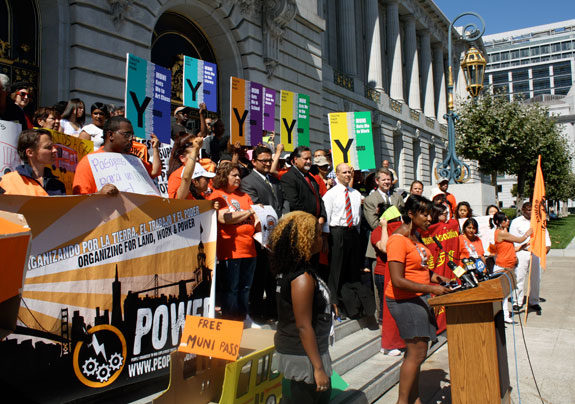
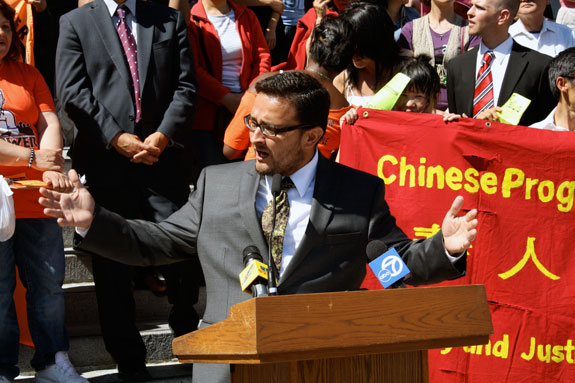
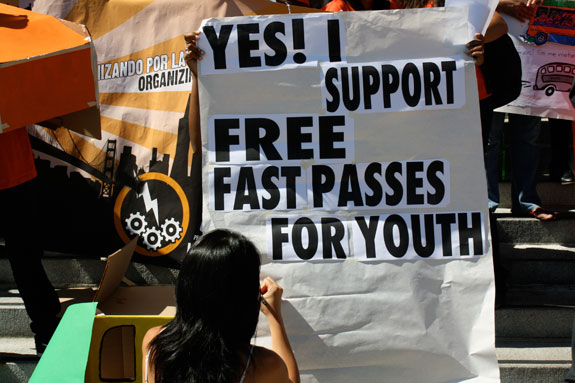
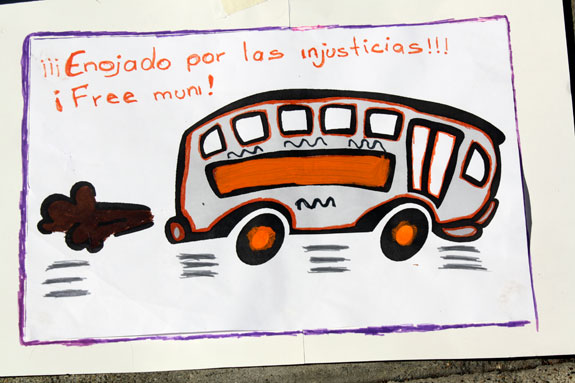
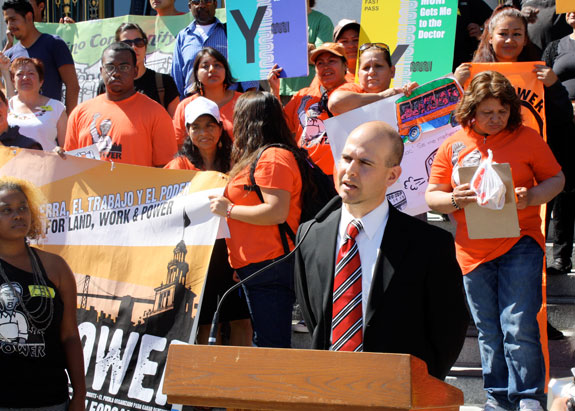
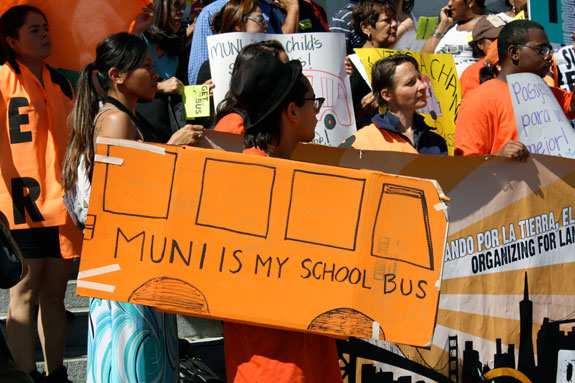
A broad coalition of community groups, youth leaders, transit advocates and elected officials called on the San Francisco Municipal Transportation Agency today to initiate a three-year pilot program to give young people ages 5 to 17 free Muni passes. The program would cost an estimated $7 million a year and result in a 4.6 percent increase in Muni ridership.
“We believe that transportation is a human right,” said Alicia Garza of People Organized to Win Employment Rights (POWER). “What we’re seeing is that over the last few years the cost of (public) transportation has increased, and service and access is decreasing. Over the last two years, there’s been more than a 100 percent increase in the cost for Fast Passes for youth.”
“For families that are struggling to survive in San Francisco,” she continued, “that also means an increase in costs when wages are not increasing, when the number of jobs in San Francisco is not increasing, and when resources for public services, including schools, are not increasing. For families with more than one child this translates into an additional burden that’s being placed on working-class families and working-class communities of color in our city.”
Earlier this year, the city adopted a one-time program to give free Muni passes to 12,000 low-income students but supporters said the demand far exceeded the supply. A Muni Youth Pass currently costs $21 and is free for kids under 5. A recent survey showed that 70 percent of students in the San Francisco Unified School District rely on public transit at a time when school bus service has been dramatically cut. The number of low-income students in the district is also high, with an estimated 61 percent taking part in the school lunch program.
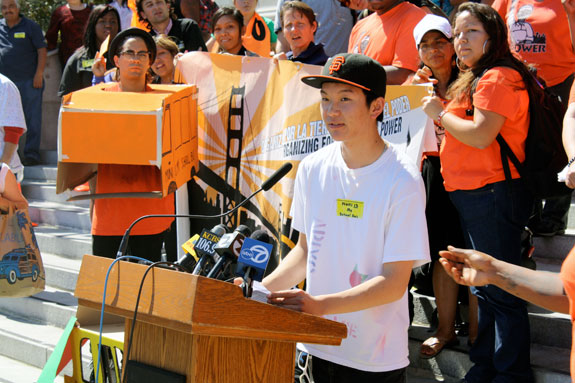
“Muni has become too expensive and the services that we depend on are becoming out of reach for us financially,” said Leah LaCroix, the chair of the San Francisco Youth Commission. “No matter what school you go to, and what your family’s income level is, or where you live, you should have access to transportation and it should be affordable and you should be able to go from your school to your after-school program to your game and wherever you want to go in the city. Free Muni does this for young people.”
The three-year pilot program, backed by six members of the Board of Supervisors, and SFMTA Board Director Joél Ramos, would be paid for “using a combination of private contributions,” “Muni efficiencies,” and “funds from several different public agencies.” While the pilot is running, those agencies would work to develop a long-term program.
Supervisor David Campos introduced a resolution [pdf] at the Board of Supervisors today calling on his colleagues to support the pilot. Ramos said he planned to get the matter agendized at an SFMTA Board meeting October 18th. He told Streetsblog one option to pay for the program could be extending parking meter hours.
“By actually generating revenues, the 7 million dollars that it might cost per year, we actually reinvest in the overall system and we make it so that parents don’t have to park anymore because their kids were on transit, so they can take transit,” he said. “That works for making parking available for people who really need it. That’s why this is a win-win.”
Paul Rose, a spokesperson for the SFMTA, said the agency is “working with the Budget Analyst to develop a comprehensive report that looks at not only what our revenue impact would be, but at what type of expenditures would be necessary to provide things like: additional vehicles, more graffiti abatement programs, or additional Clipper administrative costs, etc.”
The agency is currently facing a $23 million deficit, and recently scrapped a staff proposal to raise parking fines to help close the gap.
Thea Selby with the San Francisco Transit Riders Union said the pilot and long-term program would also include an education component for young people, and she praised POWER and other organizations working to make free Muni for youth a reality.
“They’re not just interested in giving a pass to youth. They want to train them and turn them into the transit first citizens of the next generation,” she said.
The pilot is being supported by a number of elected officials, including Supervisors Campos, John Avalos, Jane Kim, Malia Cohen, Eric Mar and Ross Mirkarimi. Organizations backing it include the Chinatown Community Development Center, Jamestown Community Center, Filipino Community Center, Public Advocates, POWER, the San Francisco Bicycle Coalition, the Coalition on Homelessness, Urban Habitat, SF Transit Riders Union, MORE Public Transit Coalition and many others.
“If we believe, as a city, that public transportation is a right and not a privilege, today we take the first step in making that a reality for San Franciscans who need it the most,” said Garza.

Read More:
Streetsblog has migrated to a new comment system. New commenters can register directly in the comments section of any article. Returning commenters: your previous comments and display name have been preserved, but you'll need to reclaim your account by clicking "Forgot your password?" on the sign-in form, entering your email, and following the verification link to set a new password — this is required because passwords could not be carried over during the migration. For questions, contact tips@streetsblog.org.