Fell Street Bike Lane Still Popular Among Bike Commuters, Parked Trucks

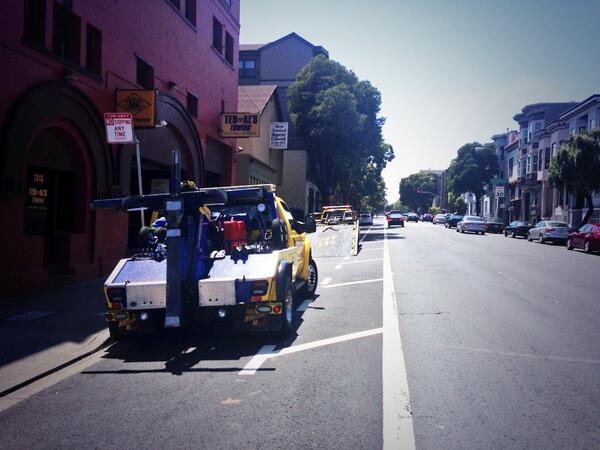
The more than 1,800 people who use the buffered, curbside bike lane on Fell Street every weekday continue to be faced with a familiar hazard: parked trucks.
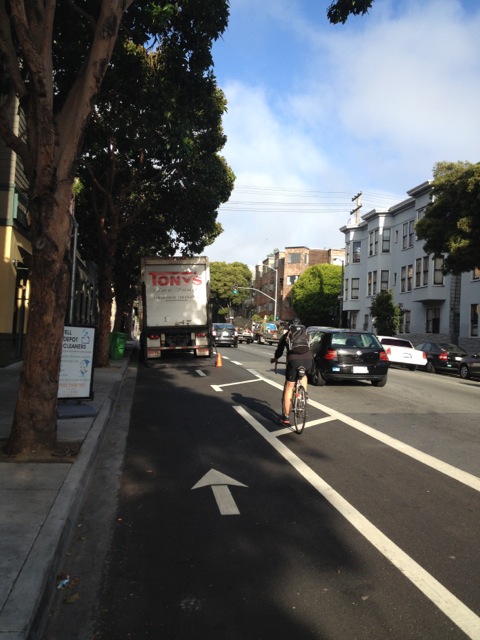
As we’ve reported, drivers, including SFPD officers, routinely park in the Fell bike lane with impunity. The vast majority of violators appear to be accessing three businesses on Fell between Divisadero and Broderick Streets: Ted and Al’s Towing, Bank of America, and Falletti’s Foods (which is actually around the corner and has a loading area). Drivers also line up along the curb in front of the Arco gas station at Divisadero, but the SFMTA made that queue legitimate by re-striping the section in 2010.
“It is so bad that frankly, there may as well be no bike lane as almost every time I ride or walk past here I see someone parking in it,” bike commuter Gisella Schmoll wrote in an email to D5 Supervisor London Breed.
Schmoll said the “worst offenders” are Ted and Al’s Towing trucks, whose drivers “are clearly not loading or unloading; often the driver is just sitting in their truck.” As a regular user of the Fell bike lane, I can also attest to that.
As reported in a nationwide study of protected bike lanes released this week by Portland State University, bike traffic on Fell increased 46 percent in the first year after the bike lane was upgraded from a skinny door-zone lane to a wide, curbside, buffered lane. All car parking along the south sides of Fell, and its one-way counterpart Oak Street, was removed for three blocks to make room for the bike lanes. The SFMTA tracks bike traffic on Fell with an in-ground sensor, and its data are posted online every day.
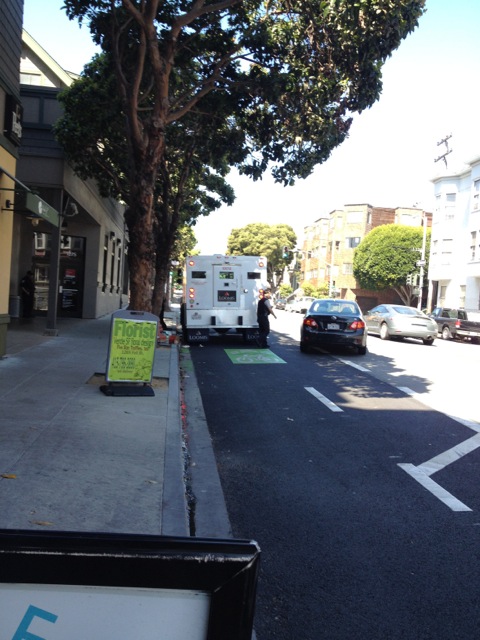
With the kind of increase we’ve already seen, imagine the boom in bicycling we might see once the bike lanes are physically protected and free of parked trucks and cars, which squeeze bike commuters alongside three lanes of heavy motor traffic.
Thanks to a push from Supervisor Breed, the existing bike lanes were on the ground by Bike to Work Day last year. Plastic posts were also installed in the buffer zones to help discourage drivers from entering them, but they were removed when the bike lanes were re-paved. There’s still no word from the SFMTA on when we can expect landscaped traffic islands to be installed in their place — crucial finishing touches that have been repeatedly delayed and were promised some time this year.
“With the city’s supposed commitment to Vision Zero, I would expect that this highly used bike lane would be a priority for both enforcement and getting a permanent physical barrier,” Schmoll wrote. “Additionally, I don’t see the point of adding biking lanes and still making it legal for delivery trucks to load and unload. Let delivery trucks block cars, not vulnerable bicyclists. If we want to get people out of their cars, reduce traffic and pollution, the first thing we need to do is make bike lanes for bikes!”

Read More:
Streetsblog has migrated to a new comment system. New commenters can register directly in the comments section of any article. Returning commenters: your previous comments and display name have been preserved, but you'll need to reclaim your account by clicking "Forgot your password?" on the sign-in form, entering your email, and following the verification link to set a new password — this is required because passwords could not be carried over during the migration. For questions, contact tips@streetsblog.org.