Memphis’s Spectacular Street Experiments Moving Toward Permanence

Around the start of this decade, Memphis’s public experiments were making its streets maybe the most interesting in the United States.
In 2010, a business district organized a live weekend demonstration of a handmade protected bike lane and revitalized commercial block. That sprouted into “MEMFix,” a rolling festival of street redesigns that did similar multi-day reorganizations of public space in spots around the city. And in 2014 the city ran a one-year trial that converted half of an expressway along the Mississippi to a walking-biking path.


It’s taken a few years, but Memphians’ hands-on experimentation with their streets is starting to pay off in permanent improvements.
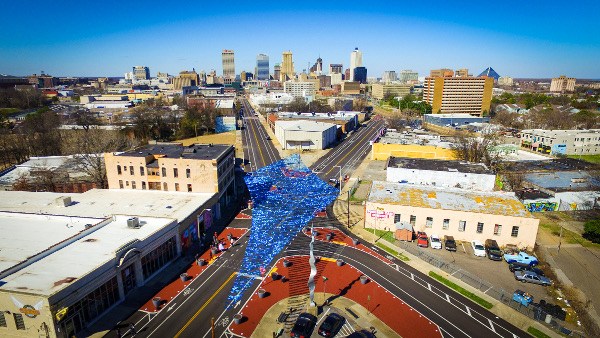
Workers are putting finishing touches on a round of changes to Memphis streets called “interim design.” The most spectacular is at the corner of Marshall and Monroe avenues, where the Memphis Medical District Collaborative and Memphis Downtown Commission co-funded a permanent set of streetscape changes based on the earlier MEMFix demonstration at the same corner.
Here’s the pilot project there, in October 2014:


And here are some shots from the latest work on the site, known as the Edge District:


Tying the intersection together is an eye-catching kite-shaped fringe designed by Memphis artist Cat Peña, inspired by the intersection’s history in the 1950s and 1960s.
“That whole area was a bunch of auto dealerships,” said Daniel Ashworth, a landscape architect for Alta Planning and Design who worked on the project. “Her piece harkens back to those overhead streamers that were typically used in those auto dealerships.”
On the streets themselves, Ashworth and his colleagues added epoxy gravel, ceramic traffic buttons as lane markers, large planters to set off pedestrian space and shorten the crosswalks, benches, trash cans, bicycle racks and a public bike fix-it station on the corner.
Ashworth described the Edge District work as the “interim design” step in the spectrum of tactical urbanism, following up on 2014’s pilot project:

“These improvements will probably last about five to eight years, and hopefully by that time the city will have decided to make some of them permanent by moving the curbs,” he said.
In the meantime, he said, this interim design will let the city test how people use the space — including collision data. If any aspects turn out to be unsafe, they’ll be cheap to correct in time for the permanent version.
Penelope Huston, vice president for marketing at the Downtown Memphis Commission, said they were enthusiastic backers of the Edge District redesign. Her group provided all the necessary support for Peña’s public art.
“Great things are going on in the Edge,” she said.
PlacesForBikes is a PeopleForBikes program to help U.S. communities build better biking, faster. You can follow them on Twitter or Facebook or sign up for their weekly news digest about building all-ages biking networks.

Read More:
Streetsblog has migrated to a new comment system. New commenters can register directly in the comments section of any article. Returning commenters: your previous comments and display name have been preserved, but you'll need to reclaim your account by clicking "Forgot your password?" on the sign-in form, entering your email, and following the verification link to set a new password — this is required because passwords could not be carried over during the migration. For questions, contact tips@streetsblog.org.