How Parking Mandates Tilt the Market Toward “Luxury” Housing

We know that minimum parking requirements — that hidden subsidy for cars and traffic embedded in (almost) every city’s zoning code — increase housing prices. In Seattle, for instance, parking mandates inflate rents at least 15 percent.
Minneapolis recently reduced its parking requirements, setting the stage for an interesting natural experiment. In mid-2015, the city changed its zoning rules for development near frequent transit, eliminating the parking mandate for buildings with 50 apartments or fewer, and cutting the old requirement of one space per unit in half for larger buildings.
Local planning aficionado Nick Magrino reports that the number of parking spaces per unit in new buildings has been declining since then, from the range of 1.2 spaces per unit in the first half of 2014 to the range of 0.7 spaces per unit more recently. Here’s a look at the trend:

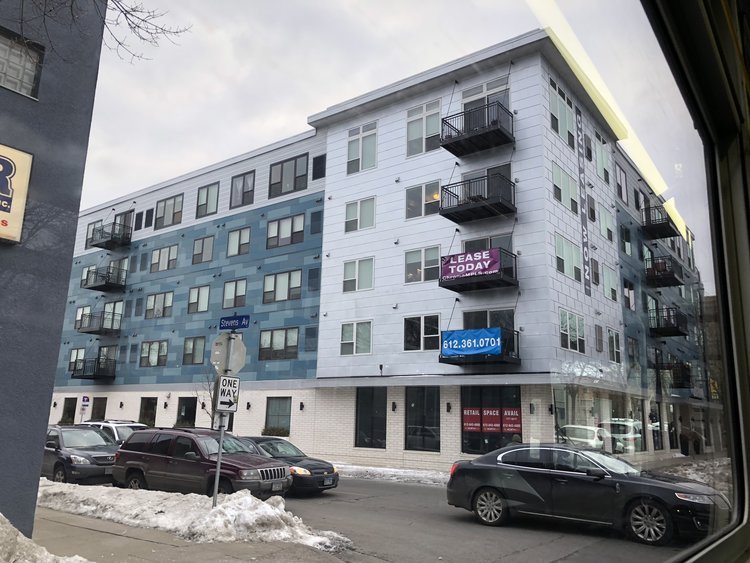
Magrino makes an interesting anecdotal observation as well. He’s seeing fewer downtown “luxury” buildings, with large platform garages on the lower floors, and more small, mid-rise buildings with some surface parking in the back and more affordable rents:
The design and rents of these places tended to be largely driven by the parking. If you’re outside of downtown, and the land isn’t expensive enough (and the zoning isn’t permissive enough) to make a tower with an above ground ramp work but it’s not cheap enough to build a surface lot, you’re going to end up digging a big hole for a parking structure. And it doesn’t often make sense to dig a big hole in the ground for a 30 unit building, so we got a lot of these six story, 200 unit l*x*ry boxes that everyone in $400,000 houses complain about in lieu of having a personality.
Underground parking spaces cost tens of thousands of dollars apiece. It’s no coincidence that we’ve been starting to see market rate, new construction housing units renting for under $1,000/month. And changing our zoning code to make that kind of unit possible eases the rent pressure on our existing housing stock, because it gets a bit less appealing to buy an existing building full of $750/month units, put in new countertops, and jack the rent up to $950/month when you can find actual new construction at a similar price point.
Good news for Minneapolis renters.
Hat tip to Alex Baca for bringing this story to our attention.