California Doing Okay, Not Bad, on Walkability – But It’s a Low Bar

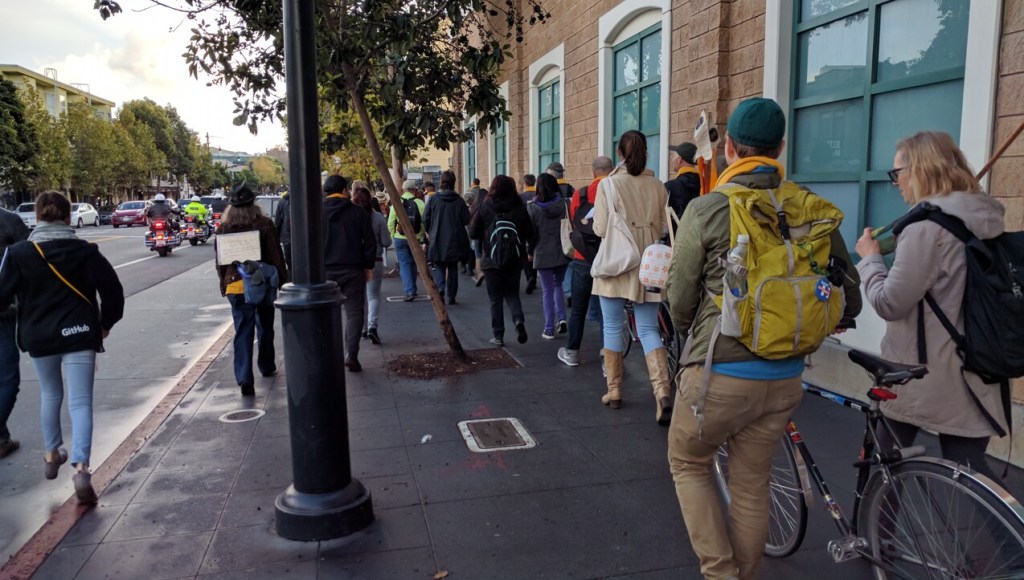
In 2015, the U.S. Surgeon General issued a call to action to “promote walking and walkable communities” to encourage Americans to take up this simple physical activity to improve their health.
Safe Routes Partnership is using the five-year anniversary of this directive to call attention to what states are doing in response. This summer, the organization issued a report card grading each state on a range of metrics related to encouraging walkable communities.
California’s grade is: Not Terrible. The state earned the highest overall score of all fifty states: 163 points out of a total of 200. The scores are based on metrics like whether the states have policies or offer funding in support of walkability, whether they focus on high-need communities, and whether they do anything to support active schools and neighborhoods.
But it’s a low bar. Many states have no Complete Streets policy whatsoever, for example. Also, an increasing number of states are diverting federal money meant for active transportation to other purposes – like highways. And 21 states offer no state funding at all for active transportation.
California, on the other hand, not only puts its own money into its Active Transportation Program, but it has not opted to use any federal active transportation money for other uses. Also, Caltrans first adopted a statewide Complete Streets policy in 2014. Although for many years that sat on the books as guidance largely ignored by its engineers, that is much less true today. That is, a strong push to seriously consider what it means to take into account all road users is taking shape. This is happening both as a result of pressure from advocates and elected leaders as well as within Caltrans itself, stemming from years of work setting up new programs and training employees as well as new leadership willing to focus on active transportation.
There is still work to be done, of course. The state’s Complete Streets policy only rates five of a total of ten possible points according to Safe Routes National Partnership’s rubric, which is fair. Caltrans’ policy states, rather vaguely, that “The Department provides for the needs of travelers of all ages and abilities in all planning, programming, design, construction, operations, and maintenance activities and products on the State Highway System.” While “travelers” should include everybody no matter which mode they use, this leaves an awful lot of wiggle room.
Where California really gets dinged is in its lack of funding for Safe Routes to Schools. This is especially true for programming that encourages active transportation, whether it be through education, events, or other ways of getting people out walking or biking. This has been an ongoing issue with California’s Active Transportation Program, which has tended to reflect leadership preferences for building infrastructure rather than funding what they tend to see as amorphous, ambivalent, squishy strategies to change human behavior – despite the fact that events like CicLAvia and bike education programs can have a profound influence on said behavior.
Appropriately, the Safe Route Partnership’s rubric divides state scores into the general categories of “Lacing Up,” “Warming Up,” Making Strides,” and “Building Speed.” That last, highest category has only been reached by two states, California and Massachusetts. It seems fitting: California cities are, with the exception of a few small areas, utterly car-dependent in a way that means walking for transportation still lies somewhere between difficult and dangerous in most places. California has started the work, and built a bit on its foundation, but the results so far are spotty.
So: Okay, California, not too bad. Keep up the good work.
Find California’s report here [PDF], and information about the scoring system, and other state scores, here.

Read More:
Streetsblog has migrated to a new comment system. New commenters can register directly in the comments section of any article. Returning commenters: your previous comments and display name have been preserved, but you'll need to reclaim your account by clicking "Forgot your password?" on the sign-in form, entering your email, and following the verification link to set a new password — this is required because passwords could not be carried over during the migration. For questions, contact tips@streetsblog.org.