Open Letter: Mayor Lurie, Here are Six Suggested Projects to go with your Safety Directive

Dear Mayor Daniel Lurie:
You released a six-page executive directive on street safety this week. From your document:
From day one, I’ve said my top priority is public safety. And that means all kinds of safety. No matter how you get around this city-walking, biking, driving, or riding transit-you should be able to do it without fearing for your life. Safe streets mean a child can walk to school without fear, a senior can cross the street with confidence, and our residents who drive can get home at the end of the day. Each year, however, dozens of people die and hundreds more experience serious or life-changing injuries on San Francisco’s streets due to traffic collisions. These losses fall disproportionately on seniors, people with disabilities, low-income residents, and people experiencing homelessness. We have learned a lot over the past ten years of Vision Zero; now is the time to update our approach to this work
You also reiterated a commitment to transit.
The directive is a good start, but you provided no real specifics. So here’s a list of six things you can help do towards your stated goals. They’re all the kinds of changes or projects that can really make life better and safer for all San Franciscans.
I’ll start with the simplest one:
1. End the Muni bike ban
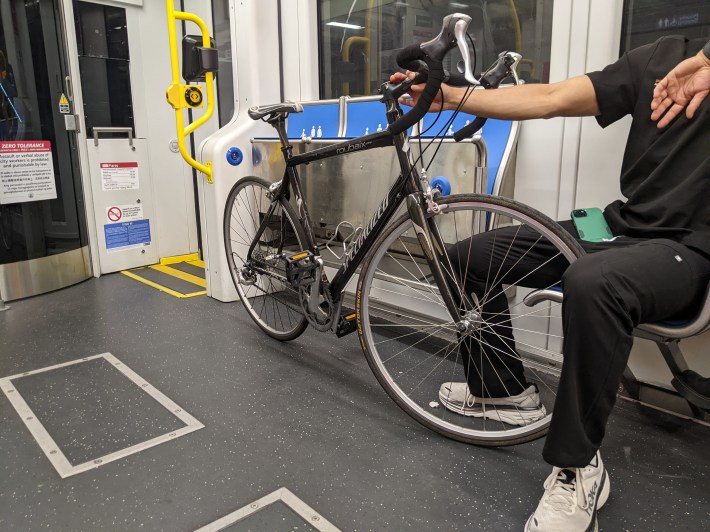
When you were at the Clipper II launch event, you may have heard SFMTA Director Julie Kirschbaum talk again about the “synergy” between bikes and transit.
So why does Muni rail continue to ban bikes?
Muni has the only rail system in the state that still bans full-sized bikes. L.A. Metro, VTA, Sacramento Transit, and San Diego all run light rail trains that are the same dimensions as Muni’s trains; they welcome bikes. There is absolutely no argument for banning bikes on Muni trains everywhere at all times, especially in the Market Street and Twin Peaks tunnels or on the T-Third, where all stations have elevators and level boarding. This would literally cost nothing and would bring in a little more revenue via increased ridership.
2. Finish Valencia Street’s bike lanes
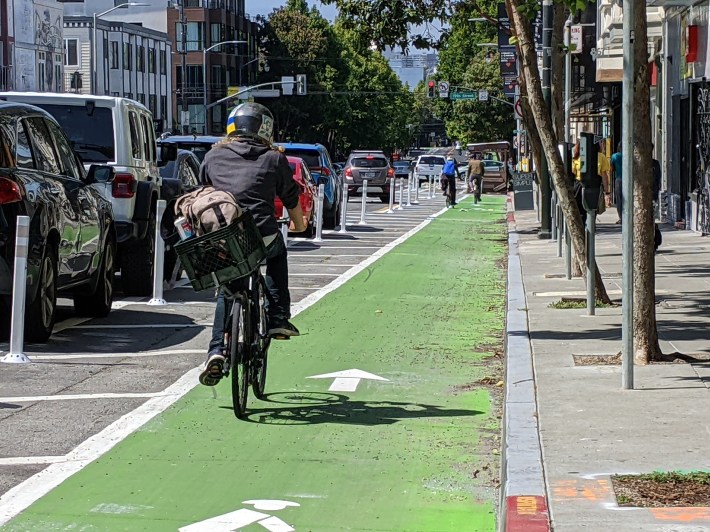
After all the turmoil over the Valencia Street bike lanes, it’s hard to believe there remains the last 2,000 feet of Valencia, between 23rd and Cesar Chavez, that still just has striped, door-zone lanes. So far, there’s been no movement on getting this project finished. You need to push SFMTA to see it through.
3. Jump Start the Arguello safety project
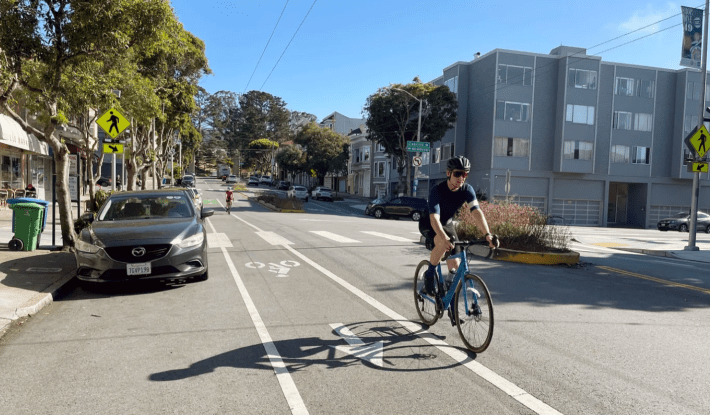
It remains a high-injury street. In theory, at least, there’s $1.3 million waiting to be spent on adding parking-protected bike lanes, dedicated to this project in 2023 after the death of cyclist Ethan Boyes. And yet, nothing is happening, thanks to the usual politics.
A mayor should be knocking heads together to make this project turn from design to concrete.
4. Issue a citywide ‘No Turn on Red’ (NTOR) policy
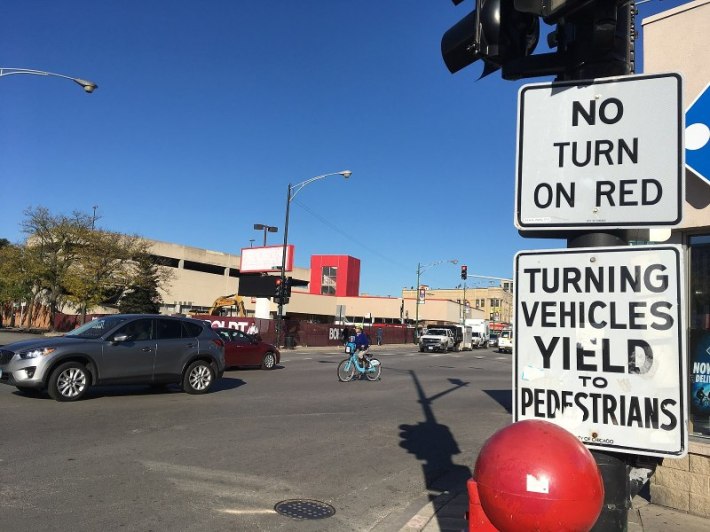
Allowing drivers to turn right on red defeats leading pedestrian interval traffic signals and puts people in danger. The success of NTOR where it’s been rolled out, has already shown this. It’s time for San Francisco to simplify its rules and ban right-on-red across the city. Streetsblog, along with advocates, has already suggested methods for threading the needle between state and city jurisdictions on this matter. The real problem is the traffic-engineer mindset that still prevails at SFMTA. Mayor Breed didn’t act on a resolution to make it happen. You can.
5. Direct SFMTA to install grade-crossing gates at appropriate locations

Muni rail, especially where it runs on the surface, is too damned slow. Between stopping at stop signs that should be signal lights that turn green for trains, to waiting for entire light cycles of turning cars, trains full of people suffer way too much delay waiting behind drivers. There is no reconciling a “Transit First” policy with forcing trains to wait for car traffic. Buy some crossing gates, install them at key locations, so trains actually go first and get preemption over cars.
And last, but not least…
6. Restore the Original Better Market Street Plan with Protected Bike Lanes
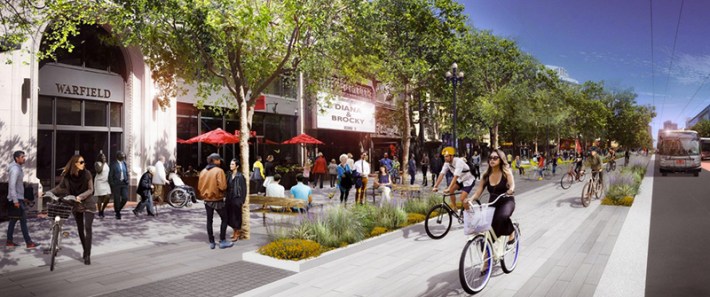
Philadelphia, which has a much smaller budget than San Francisco, is nonetheless building sidewalk-level protected bike lanes on its Market Street. In San Francisco, with the return of Waymo and some Ubers and Lyfts to our Market Street, it’s become even more imperative that cyclists are physically separated from cars, trucks, and buses.
So please order the restoration of the pre-2020 Better Market Street plan, which included curb-protected bike lanes. Philadelphia’s Market Street also has transit, a subway, and is actually 20 feet narrower than San Francisco’s. There’s no excuse for allowing this dangerous situation, with no safety segregation between cyclists and heavy vehicles, to continue.
**
I’m sure there are other delayed projects and outdated policies I’ve missed. I realize the city is facing broad financial challenges. But it’s concrete changes, not more committees and studies, that make a city a better place to live, work, and play.
I hope you will use your office’s power to see at least some of these projects and suggested policy changes to fruition next year.
Sincerely,
Roger Rudick
Editor, Streetsblog San Francisco

Streetsblog has migrated to a new comment system. New commenters can register directly in the comments section of any article. Returning commenters: your previous comments and display name have been preserved, but you'll need to reclaim your account by clicking "Forgot your password?" on the sign-in form, entering your email, and following the verification link to set a new password — this is required because passwords could not be carried over during the migration. For questions, contact tips@streetsblog.org.