Advocates Move to Save Oakland’s Parking Enforcement
Editor’s note: over the last few weeks, several sources close to and within Oakland’s city bureaucracy have reached out to Streetsblog about a troubling issue—a move is afoot to transfer parking enforcement away from the Department of Transportation. Leading advocacy groups crafted this letter recently in response and it was shared with Streetsblog:
Dear Honorable Mayor Lee and City Administrator Johnson,
We write to you today in alarm. It has come to our attention that the Administration is planning to move parking enforcement from OakDOT to Finance. While this may appear as a simple administrative shift, it is a strategic error that will undermine Oakland’s transit, safety, and economic goals. Please initiate review with Council through issuing a Statement of Purpose for their review, and delay these changes until approved by Council.
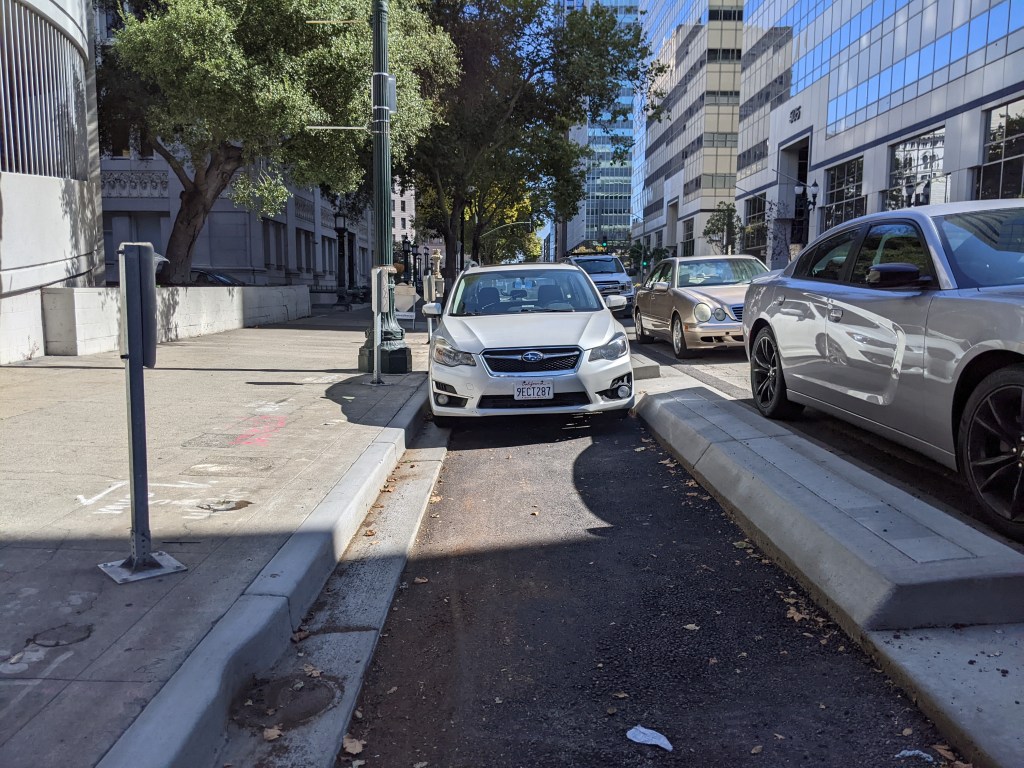
We must treat parking policy and enforcement not as a revenue stream, but as a dynamic tool for building cities. Effective curb management – through smart pricing, exclusions, and other techniques is essential for reducing congestion, supporting local businesses, and ensuring public safety. Rampant double-parking in commercial districts demonstrates this very vividly.
Providing OakDOT with the mandate to use best-practice parking management isn’t just about parking and revenue; it’s about making Oakland more accessible, productive, and livable for everyone.
Decisions about where, when, and how much to charge to park should not be a finance-based decision, but a decision about strategic management of the public right-of-way. We must stick to this. This is precisely why parking was embedded within OakDOT to begin with. In 2013, Council unanimously passed a set of parking principles that states, in part, that “Parking is part of a multi-modal approach to developing neighborhood transportation infrastructure” and that “Parking policy and regulations should help the City meet other transportation, land use, and environmental goals.” These principles remain the gold standard in urban planning. In forming OakDOT just a few years later, Council included parking policy and enforcement in OakDOT’s purview for the reasons embedded in their parking principles.
Managing parking from Finance, in contrast, reduces a complex urban planning tool to a mere revenue line item. This narrow focus ignores the broader social and economic effects on our streets. If we manage parking effectively, we will actually see a decrease in fine revenue as compliance improves. If we manage parking as a revenue stream, we erode public trust, encourage defection from the social contract, and generally make shared use of the streets worse for everyone. For a worst-case example, look at Ferguson, Missouri, as a cautionary tale of how prioritizing municipal revenue over fair policy-based solutions led to widespread public mistrust and anger even prior to the tragic events there.
A letter shared with the Bicycle and Pedestrian Advisory Commission noted that there has not been a Statement of Purpose that demonstrates any core elements needed for such a substantial decision, including:
- a defined problem statement and evidence
- a fiscal impact analysis (including one-time transition costs and ongoing overhead)
- a racial equity analysis
- operational readiness to effectively support Parking Enforcement (including workman’s comp and 24/7 field operations)
- impacts on staffing, safety, and service levels
- impacts on grants, contracts, and vendor implementations
- a transition plan, timeline, and accountable leadership structure
- an explanation of why Council review would not be required
We ask that you put a pause on this change, which will bring many negative and unexpected consequences. As well, it makes substantive changes mid-year to the budget passed by Council, and these require a proper analysis, which should be performed by the City Auditor.
We need a public airing of this proposal, and a chance for the knowledge of both the community and of transportation experts to inform any decision around this. Council legislated the move of parking to OakDOT, and Council should be the ones to make any potential changes, in regular order, and allow a public, transparent decision-making process. A more vibrant, safer Oakland starts in our shared spaces, our streets, and managing parking successfully is a key, if under-appreciated, tool for achieving this. Please do the right thing, and bring this proposal before the public’s elected representatives.
Thank you,
George Spies, Traffic Violence Rapid Response
Justin Hu-Nguyen, Co-Executive Director, Bike East Bay
Anwar Baroudi, Transport Oakland
Chris Hwang, President, Walk Oakland Bike Oakland
Jonathan Singh, Chair East Bay for Everyone
Streetsblog has migrated to a new comment system. New commenters can register directly in the comments section of any article. Returning commenters: your previous comments and display name have been preserved, but you'll need to reclaim your account by clicking "Forgot your password?" on the sign-in form, entering your email, and following the verification link to set a new password — this is required because passwords could not be carried over during the migration. For questions, contact tips@streetsblog.org.