Commentary: San Francisco Needs to Provide Real Bike Detours

Thanks to Streets Forward for its help with this piece.
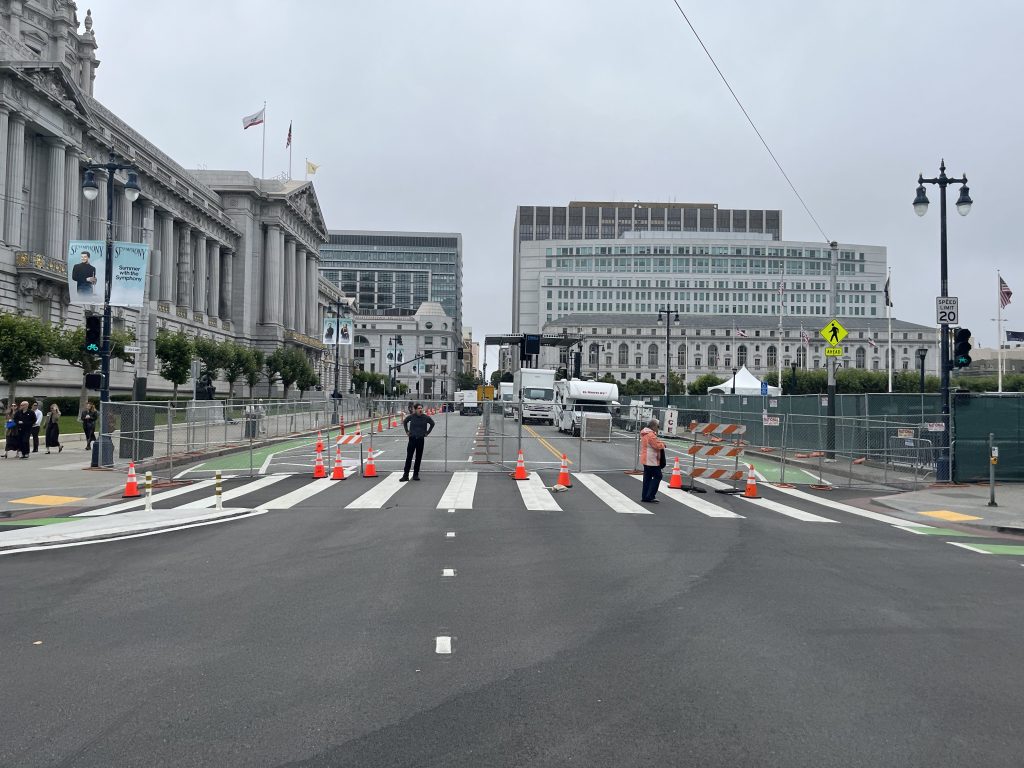
Part of Polk Street was closed for the Pride Parade last weekend. But in doing so, the city once again blocked off a protected bike lane and created no safe detour.
Streetsblog reported just last week that the Moscone Center had once again closed off the Howard Street protected bike lane, this time for the Config Global Design conference. The only thing even resembling a detour was a sign that said “detour.” An SFMTA spokesperson said the agency would look into it and respond, but they never did.
The root problem is that SFMTA’s street-closure process/application simply doesn’t require protecting people on bikes. SFMTA’s application for an event requires consideration of everything from disability parking to fire safety. But the only mention of anything for bicycling is: “Encourage attendees to ride bikes or take public transit […] You may want to add an area for monitored bicycle parking to your plans.”
Things are a little better in SFMTA’s “Blue Book” for street construction, which has an entire section on “working on bicycle routes” that includes requirements to provide alternatives, mostly for painted lanes. But it doesn’t address proper detours for separated or protected bike lanes (Class IV) such as on Howard, Polk, Valencia, and other streets.
Unfortunately, this has been a known problem in San Francisco for years.
The Netherlands or Denmark have requirements to set up protected bike lane detours during road works and construction. Even that faraway city called Oakland occasionally gets this right. Denver’s Special Event Permit Process requires “A detour plan shall be required when closing a roadway, a bike lane or a sidewalk” and “bike lanes on collector/arterial streets must be detoured to the nearest like street with a bike lane” and even and even recommends avoiding “requesting a closure for a collector/arterial roadway during “Peak Hours” and avoid disruptions to the bus lanes and bike lanes.” NYCDOT proactively installs temporary detours on adjacent streets a week in advance of major recurring events (not that they always get it right either).
Temporary measures are not that hard to do: it just requires some signs, temporary plastic or concrete Jersey barriers, and a little thought for the safety of bicyclists. But first, SFMTA has to actually add an official guideline for protected bike lanes in its regulations. Mayor Daniel Lurie could expand his Street Safety Initiative to direct SFMTA to incorporate detour requirements for protected bike lanes for permitted events.
Hosting events on our streets is important, and construction and maintenance require street closures. But construction and events happen all the time. If the city doesn’t require safe, protected detours for people on bikes, they will continually be put in danger, even on streets with hard-fought-for protected bike lanes.

Streetsblog has migrated to a new comment system. New commenters can register directly in the comments section of any article. Returning commenters: your previous comments and display name have been preserved, but you'll need to reclaim your account by clicking "Forgot your password?" on the sign-in form, entering your email, and following the verification link to set a new password — this is required because passwords could not be carried over during the migration. For questions, contact tips@streetsblog.org.