Study: Cities Must Integrate Vision Zero Principles into All Planning


A woman was killed on Market Street on Friday. A recent report shows a higher number of severe and fatal crashes in San Francisco than when the city first took its Vision Zero pledge over a decade ago.
A new study from a coalition including the Vision Zero network and the Insurance Institute for Highway Safety concludes that the core problem is that cities take the pledge to reduce traffic fatalities and serious injuries to zero, but then don’t integrate it into all aspects of planning. The “Safe System Success Stories: Proactive Injury Prevention in Transportation” evaluates projects in 13 cities by their ability to reduce crashes. It’s a template for how all cities should look at all projects.
“Across the board, across the city, cities need to make changes and align decision-making and all their funding decisions, all policy decisions, with traffic safety priorities,” explained the Vision Zero Network’s Leah Shahum. “Most cities are not doing that yet; San Francisco is not alone in that.”
More from the study:
Put simply, speed kills. Kinetic energy is the central driver of injury in road collisions. As the amount of kinetic energy in a crash increases, whether through higher velocity or greater mass, the human body is less able to tolerate the forces released. Kinetic energy risk can be managed by reducing how often and how far people drive (exposure), limiting operating speeds and vehicle mass (severity), and reducing how often road users are placed in conflict (likelihood of a crash).
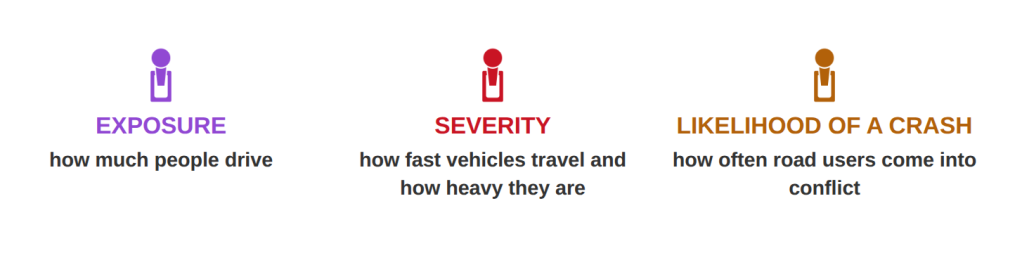
According to Shahum, those three safety levers need to be considered in every bit of planning. New York City’s congestion pricing was one successful planning example cited in the study. By charging drivers to enter the city’s most congested area, it reduces the number of cars and vehicle miles traveled, reducing exposure. It encouraged a switch to bicycles. And of course it reduces how often users are placed in conflict “by enabling street space to be repurposed for bicycle and pedestrian infrastructure. Such infrastructure separates pedestrians and cyclists from motor vehicles, reducing opportunities for conflicts.”
Closer to home, San Francisco’s Van Ness BRT also pulled all three levers because it created…
…dedicated, center-running transit lanes, reduced general-purpose lanes from three to two in most segments, narrowed lane widths, added median pedestrian refuges, programmed signals with leading pedestrian intervals, and restricted left turns for private vehicles at most intersections. These changes reduced conflict points, shortened pedestrian crossings, improved transit operating speeds and increased person throughput without roadway expansion.
Projects that don’t meet the safety criteria, she explained, simply shouldn’t be built. Shahum cited an example from Santa Rosa, which nixed a long-planned road-widening because it clearly increased exposure. “It’s not just about a project there or a project here, it’s about changing how we make decisions about widening,” she said. “If a project fails on delivering on safety, you can’t use it as an excuse that something’s been in the pipeline for a long time.”
Shahum confirmed there’s a parallel with equity-based planning, where cities require themselves to ask whether a project exacerbates disparities before it can proceed. Unfortunately, Caltrans and county departments of transportation continue to build projects that are in conflict with Vision Zero goals. Think of all the ramp widenings, which increase speeds and exposure to wrecks.
“City planners need to be unafraid and unapologetic about taking things off their plan and off the funding cycle if it’s not going to improve safety,” said Shahum.
Be sure to check out the report.

Streetsblog has migrated to a new comment system. New commenters can register directly in the comments section of any article. Returning commenters: your previous comments and display name have been preserved, but you'll need to reclaim your account by clicking "Forgot your password?" on the sign-in form, entering your email, and following the verification link to set a new password — this is required because passwords could not be carried over during the migration. For questions, contact tips@streetsblog.org.