New Jersey Transit Village Program Continues to Grow

 Image: Town of
Somerville
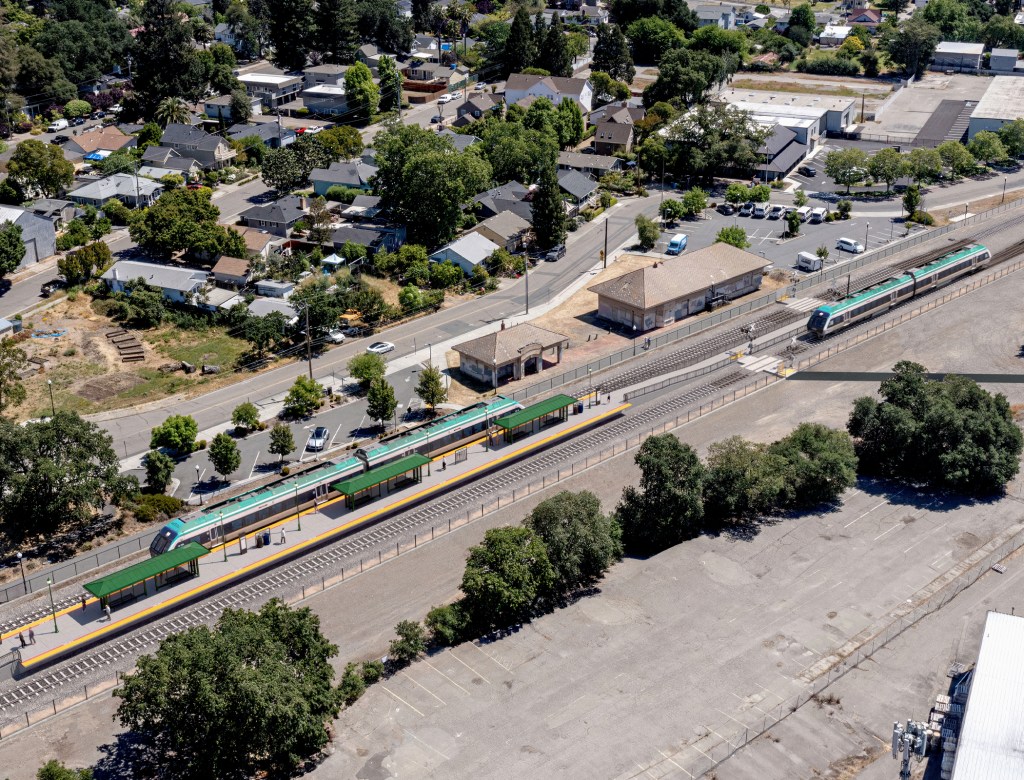
The holy grail for many urbanists contemplating long-term development
and growth trends is the transit village. Adding growth adjacent to
functional transit has the benefit of making it easier for the new
population there to drive less and use transit for a multitude of trips.
Likewise, transit villages can add to ridership on the transit lines,
no small matter for operators seeking to maintain a consistent customer
base.
Mobilizing the Region (MTR) reports New
Jersey has added its 21st and 22nd transit villages in Somerville
and Montclair. By designating the developments there as transit
villages, Somerville and Montclair will get $100,000 planning and
technical assistance grants and will move to the front of the line for
other state grants the towns may seek.
The newly designated communities are each implementing
transit-oriented development in their own way. Montclair is looking to
develop around the Bay Street station by adding a commuter parking deck,
seven residential developments with 163 units, a municipal fire station
headquarters and a day care center. Somerville’s redevelopment efforts
include plans to build a performing arts center, residential housing and
parking decks near its station, and transform 40 acres of remediated
landfill into recreation space with bike and foot trails and fields for
residents.
The new grants also got the state’s chief executive on the record
touting transit-oriented development. “The Transit Village program
encourages local officials to surround nearby transit facilities with a
vibrant mix of residential, retail and commercial uses,” New Jersey
Governor Chris Christie said in a statement. “This type of development
spurs sustainable economic growth, maximizes the value of our transit
investments and benefits the environment.”
The recent designations are not the only news in New Jersey transit
villages, according to MTR. Other communities throughout the state are
maximizing development near their existing transit infrastructure.
Existing transit villages are adding commercial and residential
development, pedestrian and bicycle amenities, and, ahem, more commuter
parking.
Elsewhere on the Network, The Fast
Lane blog examines New York City’s innovative Off
Hour Delivery Program, a pilot project funded in part by the US DOT
to alleviate traffic by encouraging commercial delivery operators to
make more deliveries at non-peak hours. The results of the pilot, which
started last October, are promising, with some trucks realizing 75
percent time savings and a reduction in parking tickets. The
Bike-Sharing Blog celebrates
Velib’s 3rd birthday by noting the world’s (now) second largest
bike sharing program has logged 80 million trips. And Commute Orlando
has an instructive
animation detailing where cyclists should ride to avoid unsafe
conditions and bad driving.

Streetsblog has migrated to a new comment system. New commenters can register directly in the comments section of any article. Returning commenters: your previous comments and display name have been preserved, but you'll need to reclaim your account by clicking "Forgot your password?" on the sign-in form, entering your email, and following the verification link to set a new password — this is required because passwords could not be carried over during the migration. For questions, contact tips@streetsblog.org.