New CPMC Hospital Deal: Smaller Campus, But More Car Parking for Its Size

The new plan for California Pacific Medical Center’s Cathedral Hill campus at Van Ness Avenue and Geary Boulevard calls for a far less massive facility than originally planned, but the number of car parking spaces per bed will actually be higher.
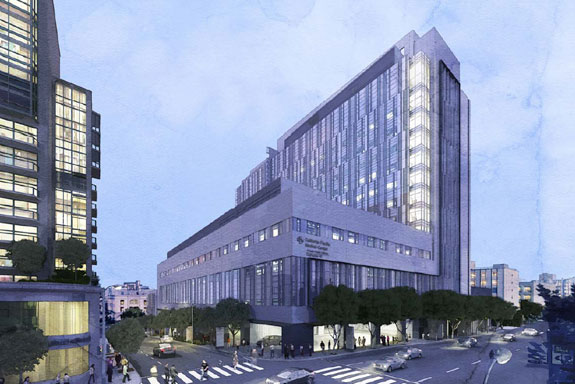
Under the new agreement announced by city supervisors yesterday, the size of the hospital will be cut nearly in half, from 555 beds to 304 beds. But the number of parking spaces included in its garage won’t be downsized at the same ratio, shedding only 210 of its 1,200 original spaces — a 20 percent reduction, according to the SF Examiner. So while the facility may bring in less car traffic as a whole, it will actually be more car-centric compared to the original plan.
“There’ll be a lesser impact on transit from traffic, but it’s only because they made the hospital smaller, not because they got any smarter about transportation,” said Livable City Executive Director Tom Radulovich.
Of the location at Van Ness and Geary, Radulovich says, “If you were going to pick a spot that’s not on Market Street where you could do the most damage to transit, Van Ness and Geary is pretty much it.”
The $14 million that CPMC has agreed to pay the SF Municipal Transportation Agency to help fund Van Ness and Geary Bus Rapid Transit projects was also reduced from the $20 million included in the development agreement as late as November, according to the Chronicle (though it’s still more than the $10 million Mayor Ed Lee originally asked for in 2011).
As for funding pedestrian and streetscape improvements, the agreement calls for the institution to provide $13 million — $5 million less than the mayor’s original ask. Those funds would go towards upgrades in both the Mission, where CPMC is also planning its now-upsized St. Luke’s hospital at Valencia and Cesar Chavez Streets, and the Tenderloin, where long-neglected pedestrian safety needs will only become greater as the Cathedral Hill campus induces more driving on the neighborhood’s streets. Whether or not parking will be added to the St. Luke’s campus, which has been upsized in the deal from 80 beds to 120, is unclear.
The original plan for a Cathedral Hill campus with 1,200 parking spaces estimated that it would bring 10,000 new daily car trips. A traffic analysis for the new configuration is not yet available.
According to a press release from the mayor’s office, “CPMC will institute a robust transportation demand management program to manage traffic congestion at hospital facilities and encourage use of public transit, including ongoing monitoring of traffic conditions around the Cathedral Hill campus.” However, the details of that program aren’t immediately available. CPMC’s transit incentive programs at its other campuses have not demonstrably curbed car commuting.
At their board meeting yesterday, city supervisors universally praised the new deal. The only mention of transportation issues came from Supervisor David Chiu, who gave an overview of the provisions, but didn’t specifically comment on them.
According to Chiu, access to the Cathedral Hill parking garage will be limited after 7 p.m. to drivers with hospital business. It’s unclear if the agreement still includes the mayor’s original proposal that CPMC pay the SFMTA 50 cents for each garage entry and exit during peak hours, and a 25-cent fee during off-peak hours.

Read More:
Streetsblog has migrated to a new comment system. New commenters can register directly in the comments section of any article. Returning commenters: your previous comments and display name have been preserved, but you'll need to reclaim your account by clicking "Forgot your password?" on the sign-in form, entering your email, and following the verification link to set a new password — this is required because passwords could not be carried over during the migration. For questions, contact tips@streetsblog.org.