BART Meltdown Highlights Vulnerability of Bay Area Infrastructure

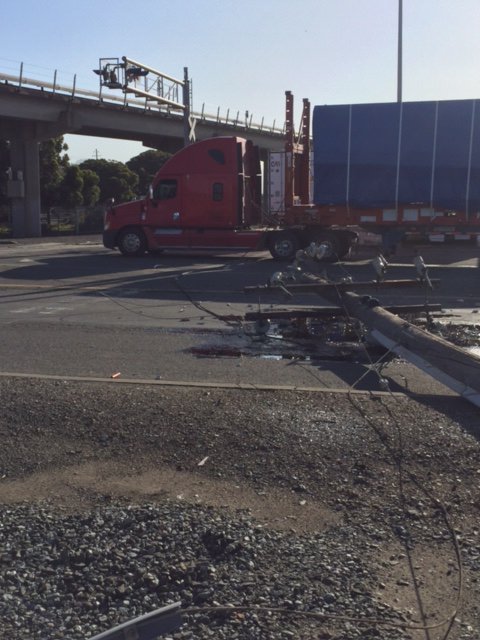
One errant motorist crashed into a telephone pole and paralyzed the Bay Area this morning at 8:30, right in time for peak rush hour crowds.
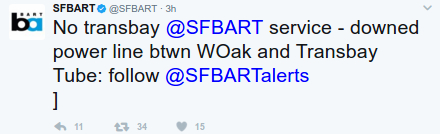
From BART’s Twitter feed:
The power line fell onto the BART right of way and trains couldn’t proceed until it was removed. Mainstream TV and newspapers ran pictures of some of the 400,000 frustrated commuters who use BART daily. Some tried to use car services, others crowded onto ferries and buses, but many simply had to go home. Service was restored about 90 minutes later, going by the timing of BART’s Twitter announcements. Residual delays continued for hours.
The incident was, for sure, frustrating. But, more importantly, it highlights just how vulnerable the Bay Area is to service disruptions.
What happens when it’s a derailment? Or an earthquake? Or a terrorist attack? What happens if Transbay is taken out for a few days, or a week, or longer?
“It’s not acceptable to have so little transportation network redundancy between the biggest nodes in the Bay Area,” said Ratna Amin, Transportation Policy Director for the San Francisco Bay Area Planning and Urban Research Association (SPUR). SPUR, along with other Bay Area advocacy groups, have long argued for a second Transbay tube. The issue, of course, is the cost: at around $13 billion, polling showed last year that voters would not pass Measure RR if it included funding for a second tube. It does, however, have some money to begin studying options, and Streetsblog hopes this morning’s incident can act as a reminder to get that in motion.
It also highlights the stupidity of Transportation Secretary Elaine Chao and the Trump Administration in cutting off federal funds for Caltrain electrification. What does that have to do with Transbay? SPUR studies and others have long concluded that a second Transbay crossing should be built to permit Caltrain to reach the East Bay. Electrification, combined with a Transbay tube built to standard gauge, would give Caltrain the same or greater capacity than BART. So cancelling the electrification funds may have also pushed Transbay redundancy off even further into the future. One can only hope the administration’s infrastructure plans will look at some of these vulnerabilities, in the Bay Area and other US economic centers, but so far that seems unlikely.
And in case you’re one of those people who thinks rideshare, or even driverless cars, can provide a suitable backup, this:

It’s not that there won’t ever be service problems if a second Transbay tube is built, but at least there would be a real backup for people trying to get to work. And that means a major failure of the existing Transbay tube wouldn’t have to crush the Bay Area economy. “These kinds of transit malfunctions aren’t going away and we can anticipate bigger transit disruptions to come in the Bay Bridge corridor,” said Amin.
Were you prevented from getting to work this morning? Did you try to get a bus, ferry or car across the Bay? How was information communicated by BART? And what do you think this incident says about the future vulnerabilities of the Bay Area to service disruptions?
Post your comments and pics below.

Streetsblog has migrated to a new comment system. New commenters can register directly in the comments section of any article. Returning commenters: your previous comments and display name have been preserved, but you'll need to reclaim your account by clicking "Forgot your password?" on the sign-in form, entering your email, and following the verification link to set a new password — this is required because passwords could not be carried over during the migration. For questions, contact tips@streetsblog.org.