Why Are Florida’s Streets So Deadly for Cycling?

Florida has a well-earned reputation as a dangerous place to bike. In 2014, 139 bicyclists lost their lives on Florida roads. They accounted for 20 percent of total cyclist fatalities in the U.S. that year, in a state with just six percent of the nation’s population. A recent study funded by the Florida Department of Transportation takes an in-depth look at why its streets are so deadly — and what can be done to change that.
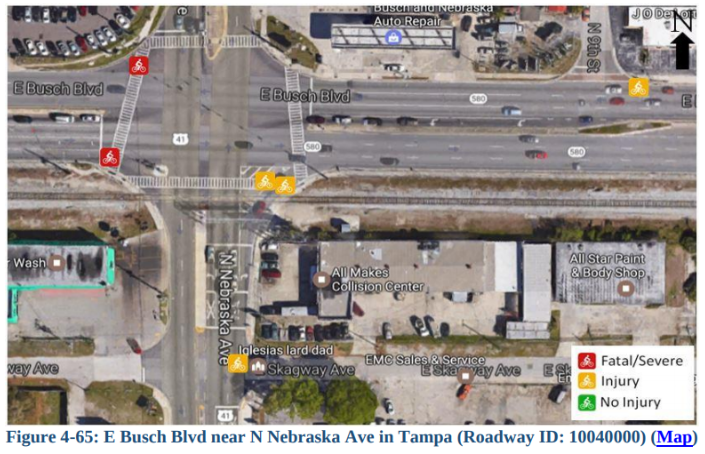
Researchers at Florida International University reviewed police reports for the 2,954 bicycle collisions at five “hot spots” with the most bike crashes in each of FDOT’s seven regional districts, between 2011 and 2014.
In 46 percent of crashes, the driver was found to be at fault, while cyclists were at fault 30 percent of the time. Crashes at these locations typically involved drivers turning left or right, or cyclists and drivers pulling out into an intersection with cross traffic.
The authors analyze these types of crashes in detail and recommend engineering changes to improve safety, such as leading pedestrian intervals, which hold back turning drivers and could allow cyclists a head start. They also suggest tightening street corners so drivers make turns at slower speeds, and installing speed humps to slow drivers who run stop signs.
“The findings and recommendations developed in this report will assist designers and planners in the continuing effort to improve bicycle safety on Florida roadways,” FDOT said in a summary of the study.
Asked for more detail, however, Joseph B. Santos, FDOT’s state safety engineer, was noncommittal. “The research efforts did showcase initial findings from key bicycle countermeasures,” he said, “but will need to be vetted before being potentially incorporated into department policies and procedures.”
The researchers also found some interesting patterns in an analysis of all 10,546 bicycle collisions statewide from 2011 to 2014.
Fatality rates varied greatly throughout the state, from a low of 3.8 deaths per million people in Miami-Dade County to a high of 10 deaths per million people in Pinellas and Brevard counties. Census blocks with high portions of car-free households were more likely to be the scene of bicycle crashes, though not necessarily fatal ones, as were areas with high proportions of black or Latino residents.
Bicycle crashes were more likely to result in death or injury on streets with higher speed limits, and multi-lane roads were more deadly than narrower streets.
Large vehicles are also particularly deadly; more than 14 percent of bike crashes with medium and heavy trucks caused death, compared to just 1.7 percent of crashes with passenger cars.

Read More:
Streetsblog has migrated to a new comment system. New commenters can register directly in the comments section of any article. Returning commenters: your previous comments and display name have been preserved, but you'll need to reclaim your account by clicking "Forgot your password?" on the sign-in form, entering your email, and following the verification link to set a new password — this is required because passwords could not be carried over during the migration. For questions, contact tips@streetsblog.org.