BART Makes Some Progress on Noise

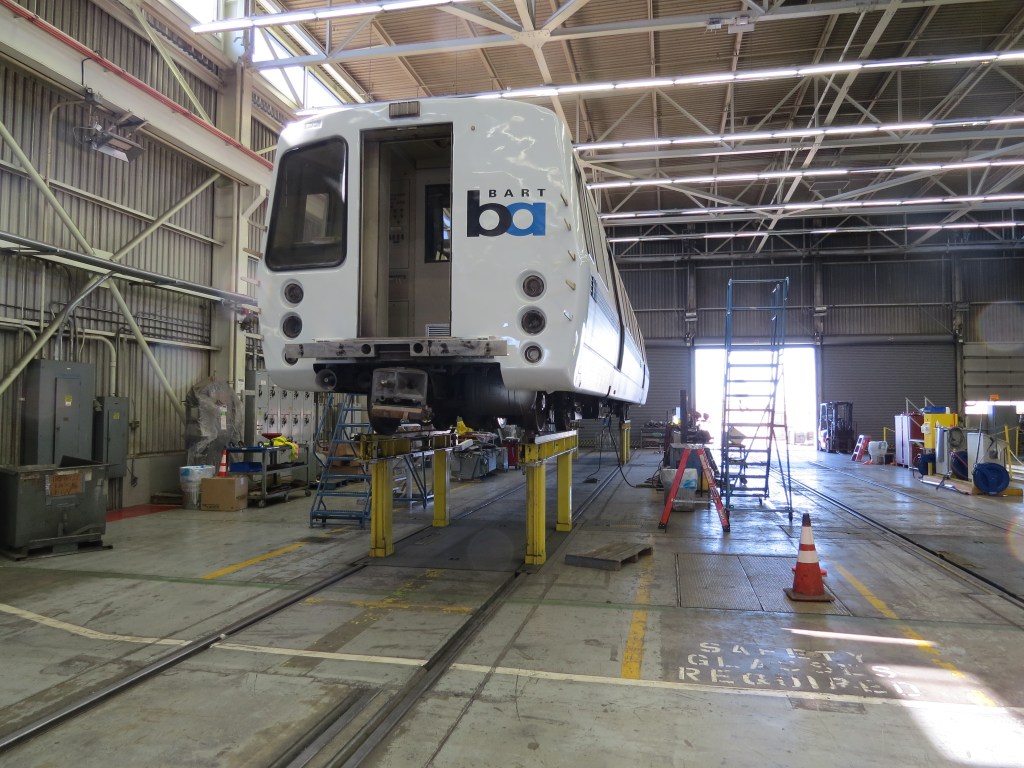
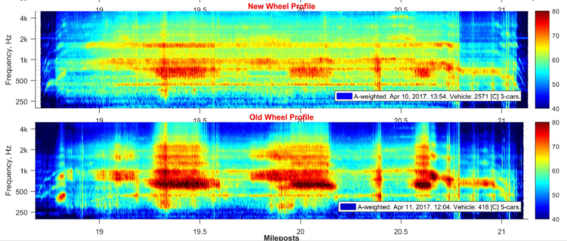
BART has been busy reshaping its wheels as part of a strategy to reduce the system’s notorious howl. Initial results show it’s working. “The new, reduced-contact wheel profile has shown as much as a 15 dB decrease in interior noise on the current fleet” wrote the transit operator in a release put out today. “By slightly tapering the wheel profile using the latest simulated modeling techniques, we hoped to reduce metal-on-metal contact and its consequences.”
15 dB may not seem like much, but the decibel scale is logarithmic—like the Richter Scale—meaning just a few points of numerical difference represents a huge improvement in noise reduction. BART provided this visual representation of the noise levels of the new and old wheel profile:
As Streetsblog readers will recall, BART’s new trains–the first ones should show up in service around Thanksgiving–have a tapered or conical cross-section to its wheel, which is standard on railroads throughout the world. However, when BART was designed back in the 1970s, its engineers opted for a flat wheel profile. The idea was to reduce the amount of side-to-side jostling that can occur on a train at higher speeds. However, it resulted in excessive and uneven rail wear, notably on curves. The flat, 1970s-designed wheels, over time, grind an oscillation pattern into the rails–known as corrugation–and, in effect, turn them into miles-long, hideous-sounding violin strings. That’s why legacy subway systems, such as New York’s, are loud, but don’t produce BART’s uniquely deafening howl.
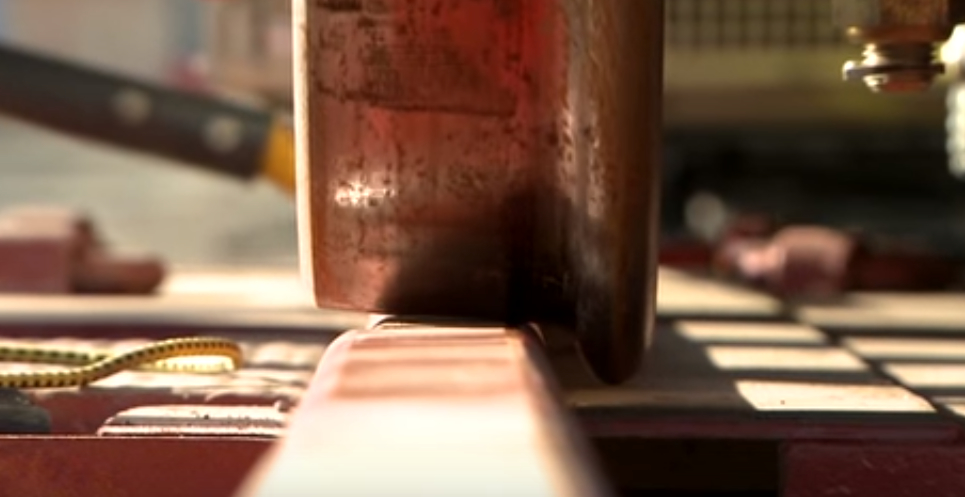
Of course, don’t throw out your ear plugs yet. “Currently, 13 percent of our legacy fleet has been outfitted with the new wheel profile,” wrote BART officials, “and we estimate 90 percent will be converted by the end of 2019.”
As the new wheels are phased in, BART will have to grind the rails smooth to remove that “violin string” corrugation pattern. The agency says the rail grinding will “… take place during maintenance hours overnight over approximately five years. There will be three phases, with six grinding passes per phase over the entire 235-mile system. That’s roughly 4,000 miles of rail grinding between now and 2022, about the same distance as a drive from San Francisco to Chicago and back.”
By then it might actually be possible to have a conversation on BART without yelling.
Note: GJEL Accident Attorneys regularly sponsors coverage on Streetsblog San Francisco and Streetsblog California. Unless noted in the story, GJEL Accident Attorneys is not consulted for the content or editorial direction of the sponsored content.

Streetsblog has migrated to a new comment system. New commenters can register directly in the comments section of any article. Returning commenters: your previous comments and display name have been preserved, but you'll need to reclaim your account by clicking "Forgot your password?" on the sign-in form, entering your email, and following the verification link to set a new password — this is required because passwords could not be carried over during the migration. For questions, contact tips@streetsblog.org.