Commentary: Parking Spaces for People

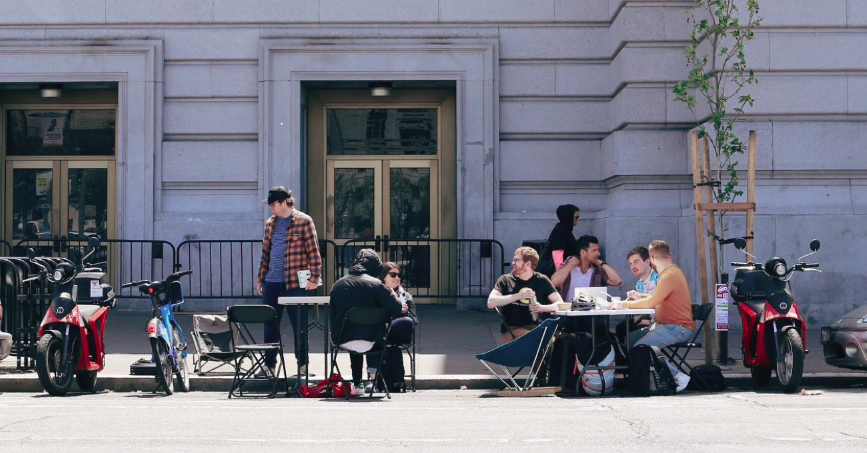
Street safety advocates have shown with Park(ing) Day and WePark that our streets can be put to better use: for people, rather than cars. Some are now asking: could parking spaces be used in some way to help the homeless?
There are legitimate safety issues with allowing tents in parking spaces: since tents are unprotected, angry or careless motorists can cause harm to already vulnerable people.
However, some kind of crash-protected, modular housing might work. Single-person dwellings can be constructed in parking spaces. Pit stops, also occupying parking spaces, should be expanded across the city and be open 24 hours, to provide dignity for residents of this new housing.
High land prices (due to high demand and low availability) and high construction costs (due to labor shortages) along with a time-consuming and expensive process are the largest cost drivers for new housing. However, we already subsidize the cost of the land for private vehicle storage, so the incremental land cost is free. Since modular housing is built off-site with inexpensive materials, it is also much more affordable to build. SFMTA already has a process for blocking off parking for construction and storage, so it’s hard to see why this use should be prohibited under existing laws. Furthermore, San Francisco is already proposing legalizing vehicular homes (which are unaffordable to most chronically homeless).
There are an estimated 7,500 homeless people on San Francisco streets on any given day. There are at least 275,000 on street parking spots, so less than 3 percent of parking spots have to be re-purposed to house the entire homeless population. Since parking spots are distributed throughout the city, we can ensure equitable geographic distribution.
Nearby San Jose has estimated the cost per unit of less than $20,000. The total comes down to $150 million, significantly less than the proposed affordable housing bond of $500 million. With the same funding we can solve homelessness and build affordable housing for more people.
So why is this not being seriously considered? Is it because it’s so politically hard to reduce parking? Transportation and housing advocates should unite on this issue: let’s put people first on housing and safety.
What are your thoughts on this? Post below.

Streetsblog has migrated to a new comment system. New commenters can register directly in the comments section of any article. Returning commenters: your previous comments and display name have been preserved, but you'll need to reclaim your account by clicking "Forgot your password?" on the sign-in form, entering your email, and following the verification link to set a new password — this is required because passwords could not be carried over during the migration. For questions, contact tips@streetsblog.org.