Op-Ed: Don’t Blow Sunday Streets
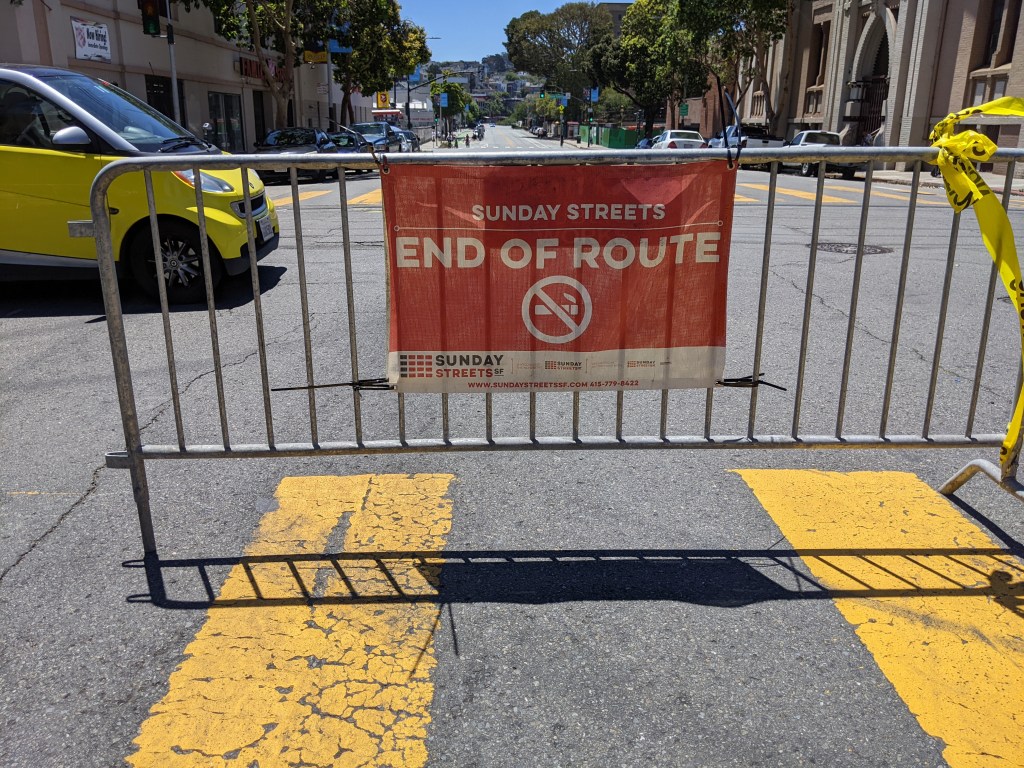
San Francisco’s proposed FY 2026–2027 budget included a $17 million cut to the Department of Public Health (DPH) funding for Community-Based Organizations (CBOs). As a result, DPH cut its entire $215,758 contribution to Sunday Streets — the 18-year-old program that transforms streets in the Tenderloin, Bayview, SOMA, Mission, Excelsior, and Western Addition into car-free corridors for neighbors, local vendors, community organizations, and food trucks every summer.
This funding represented 43% of the program’s $500,000 budget, causing the nonprofit behind it, Livable City, to launch a funding drive to keep the program alive. The DPH Memo explaining the reasoning behind the cuts states the department needed to focus on “preserving direct health and clinical services.” This points to a fundamental framing problem: when programs that reduce air pollution, increase physical activity, and strengthen social cohesion aren’t recognized as health interventions, the communities that need them most are the ones who lose them.
For context, then-SF mayor Gavin Newsom launched Sunday Streets in 2008, inspired by a global movement that started in Bogotá, Colombia in 1974 when a group of residents closed 5 kilometers of road to cars for a few hours and called it Ciclovía. That experiment grew into a weekly institution covering over 100 kilometers of the city, and has since inspired over 400 cities (mostly in Latin America) to create their own open streets programs. Cities across the world, many facing far more constrained budgets and infrastructure challenges than San Francisco, have managed to sustain and scale these programs because they recognize them for what they are: public health infrastructure. Sunday Streets is SF’s version of that vision: open-air street events in high-density neighborhoods with minimal access to open space.

Sunday Street neighborhoods are the parts of San Francisco most harmed by traffic and pollution. Low-income communities like SOMA, the Tenderloin, and the Bayview are disproportionately burdened by air pollution, largely due to their proximity to freeways. Asthma and COPD hospitalization rates in the Tenderloin, SOMA, and Bayview are among the highest in the city, and are nearly ten times higher for Black/African American residents than for white residents. About 28% of SOMA residents live in areas where air pollution creates an elevated cancer risk, and SOMA has one of the highest concentrations of low-income households among the impacted neighborhoods.
In Bayview specifically, the health burden is massive. Studies from as early as 1995 have documented higher-than-normal cancer rates among Bayview residents, and a 2006 survey by the city’s own health department found that 86% of babies born in Bayview developed severe asthma before starting kindergarten.
This is the backdrop against which DPH is canceling one of the few programs that temporarily gives these neighborhoods something they rarely have: clean air and open space.
The research on the benefits of open streets events is clear. A UCLA study of CicLAvia, LA’s equivalent of Sunday Streets, found that ultrafine particle pollution dropped 21% and fine particulate matter (PM2.5) fell 49% on closed streets during the event. Even surrounding streets that remained open saw pollution levels fall 12% compared to non-event days. Research on Ciclovía programs more broadly confirms that beyond physical activity, these events measurably reduce particulate pollution and street noise. As Livable City’s Tom Radulovich put it: “This is a public-health intervention at a different level.”
Social isolation, sedentary behavior, and chronic stress are all recognized health metrics. A program that gets thousands of people outside, moving, and connecting with their neighbors in areas that have almost no parks or green space isn’t just a street fair — it’s preventive medicine, and at $215,000, it represents just 0.0013% of the city’s $16.2 billion budget.
I’m well aware of the dramatic cuts that will need to be made in the City’s budget, largely due to the longtail impacts of the pandemic on the City’s general fund. However, key open streets programs like Sunday Streets shouldn’t be scrapped under the guise of protecting direct health services — they should be supported in recognition of the health services they’re already providing to low-income communities of color across San Francisco.
Livable City is trying to raise that $215,000 to save this summer’s season. They’ve raised about $31,500 so far. If you want to donate, share or write to city officials, you can find info at livablecity.org/sunday-streets-advocacy.
***
Chris Kucera is a climate and transportation advocate and Clean Transportation intern at the San Francisco Environment Department. He holds an MBA in Sustainable Solutions from Presidio Graduate School and lives in San Francisco’s Alamo Square neighborhood
Streetsblog has migrated to a new comment system. New commenters can register directly in the comments section of any article. Returning commenters: your previous comments and display name have been preserved, but you'll need to reclaim your account by clicking "Forgot your password?" on the sign-in form, entering your email, and following the verification link to set a new password — this is required because passwords could not be carried over during the migration. For questions, contact tips@streetsblog.org.