BART’s “Air Traffic Controller” Has a Unique View of the Importance of Transit

Kelly Robinson has worked at BART for 30 years, since shortly after she graduated from high school. She thinks of it as the “family business.” Her father started working as a train operator in 1973. (The first segments of the system opened in 1972.) As a child, she’d cut school to joyride with her BART pass. “I’m as BART as it gets,” she said.
Her current position as a rail operations controller (ROC) gives her a bird’s-eye view across the whole system. We spoke with her about what goes on behind the scenes at BART’s control center, her vision for the future of transit, and why she thinks it’s critical to pass the Connect Bay Area measure in November.
BART’s “air traffic control” room
The best way to describe BART’s Operations Control Center, where ROCs work, is to compare it to air traffic control. “We’re in charge of all passenger, employee, and equipment safety,” Robinson said. ROCs control everything trackside except the railyards.
While train operators are the eyes of the system, rail operations controllers are the beating heart and the brains. The ROCs fix mistakes, figure out how to get trains back on schedule and keep trains in sequence, and respond in under a minute when something goes wrong.
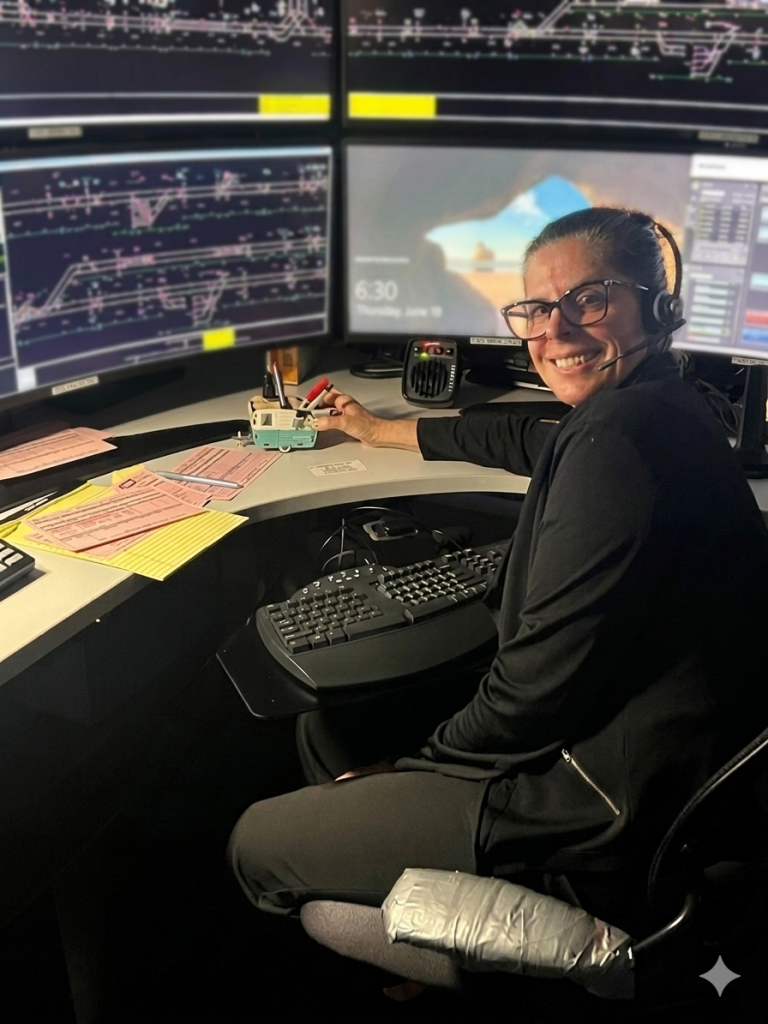
“I’ve been doing it now for 17 years. The thing that I like best about my job is that I’m always challenged,” she said. “We have to keep navigating our way through whatever the system is throwing at us that day.”
BART’s ROCs work under pressure, surrounded by monitors that show them the status of trains across the system. When there’s an emergency—train breakdown, switching problem, medical emergency, BART police action, or any other unpredictable situation—Robinson and her coworkers swing into action. They notify other emergency responders, sending help as quickly as possible.
That pressure and the need to think on your feet might be why the position is understaffed. Controllers typically work 12-hour shifts and often work overtime, clocking in as much as 60 hours in a week.
Getting people where they need to go
As any BART commuter knows, it’s the fastest way to get across the Bay—and to many other destinations—until something goes wrong. That’s when ROCs are crucial, ensuring everyone stays safe while they resolve the issue.
“Once you have an occurrence like that, we can’t manage that many trains in that area,” she said. “We have to get creative and figure out how to get people where they’re going with a big hurdle in their way.”
Robinson works to figure out how and where to divert traffic so trains don’t get stuffed into the Transbay Tube. She can’t get everyone to their destination on time, but her job is to figure out how to serve as many passengers as possible around the blockage. The airport is the first priority. She looks at where she can get people to stations where they can transfer to other lines.
“What people don’t know is how important it is for us to react to isolate an incident area,” Robinson said. Her goal is always to make the incident area as small as possible, which means keeping other trains out of harm’s way.
The job is often stressful, but Robinson said, “I love it. I feel like I can make a difference to someone’s day.”
Best- and worst-case BART scenarios
As a lifelong BART rider and operator, Kelly Robinson is keenly aware of the vital role transit plays in people’s lives. She’s been talking up the Connect Bay Area ballot measure to anyone who’ll listen, and many of her fellow AFSCME union members were among the more than 1,000 people who gathered signatures to place the measure on the ballot as a citizen initiative.
BART currently runs trains with 20-minute maximum headways; if the funding measure fails, passengers could wait 60 minutes between trains, and many stations would be forced to close. “Not having the funding would send us in a spiral in the wrong direction,” Robinson said.
When asked about the future of BART, Robinson lays out a bold vision that starts with 10-minute headways but goes much further. “When BART was created, it was state of the art. The entire world was reveling in this transit system,” she said. “With our extensions, I would have liked to see all-new technology.”
Imagine a world where we spent as much time, money, and brainpower innovating transit for people as we do trying to put a few people into outer space. The Connect Bay Area ballot measure won’t provide SpaceX-level funding, but it’s a big step toward a brighter transit future for the Bay Area.
A version of this post also appeared on the Transform Bay Area website and is used here with permission.
Streetsblog has migrated to a new comment system. New commenters can register directly in the comments section of any article. Returning commenters: your previous comments and display name have been preserved, but you'll need to reclaim your account by clicking "Forgot your password?" on the sign-in form, entering your email, and following the verification link to set a new password — this is required because passwords could not be carried over during the migration. For questions, contact tips@streetsblog.org.