Op-Ed: Let’s Make it Easier to Take Transit to Golden Gate Park
San Francisco is going to charge for parking at Golden Gate Park, which was previously free. Rates will be anywhere from $1.25 to $4 an hour, similar to other metered parking around the city. While Donald Shoup would have been a fan of this policy, not everyone seems to be.
But doing what the city needs and what’s right is not always popular. Charging for parking is needed and recommended both to fund Rec and Parks and to free up parking spaces within Golden Gate Park. It will encourage folks to take Muni, ride their own bicycle, or use one of the newly added Lyft bikeshare docks. Our city should provide residents with access to beautiful, maintained parks and robust, equitable ways to get there.
A billionaire steps in, or how not to plug a deficit
This new policy has been in the works since February 2025 to help plug a yearly $15 million deficit that Rec and Parks faces due to budget cuts. If Rec and Parks can’t plug this deficit, basic services like cleaning, maintenance, and park programs may take a hit.
In the midst of this dilemma, a generous billionaire, Brian Chesky (the CEO of Airbnb), has decided to donate $100 million to SF Rec and Parks. When a billionaire donates money to the city, it can be a welcome windfall to cover the cost of important projects. But rich philanthropists generally want to tie personal donations to their legacy. They prefer naming rights or want to fund grand projects (like the Artist Hub on Market), not the nitty-gritty of day-to-day operations funding. And when times get tough, billionaires are often ready to get going (e.g., Benioff talking about moving Dreamforce away from SF during its post-COVID bust).
A reliable way to secure long-term funding for important services like Rec and Parks is to implement user fees. Pricing for usage of government services (like street space in a park!) is a stable funding source. Pricing for parking specifically helps reduce negative externalities such as traffic and air pollution from exhaust and tire particulates. Parking fees also help increase availability and reduce the need to circle around, especially in such a popular destination like GGP, which regularly reaches full street parking capacity.
Moreover, this is an opportunity to improve other, more sustainable ways to get to the park (like Muni!).
Give the public – transit!
San Francisco is, by City Charter, a Transit First city. That resolution, adopted in 2007, mandates the city to focus on solving transportation problems by improving public transit, walking, and bicycling.
SFMTA is actively thinking about transit access to parks and put out an analysis of all the “one-seat rides” to Golden Gate Park.
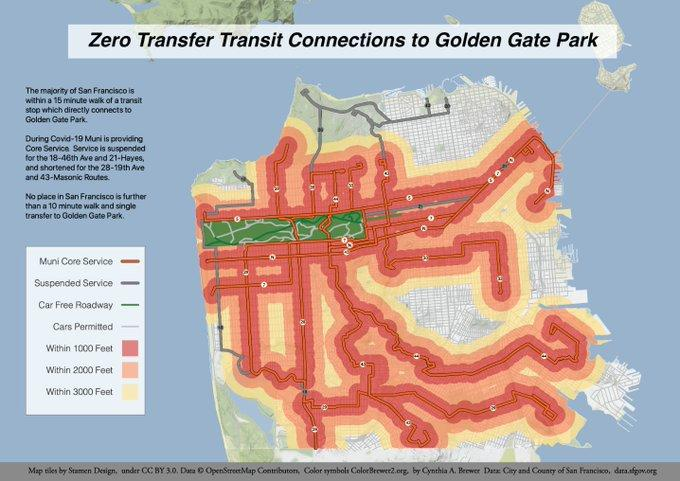
Source: https://www.sfmta.com/blog/plan-your-next-golden-gate-park-trip-muni .
The level of coverage here is strong, and it touches a vast majority of the city. Muni should be applauded for enabling hundreds of thousands of residents to access the park for at most $3 (discounted for seniors / disabled / Medicare and free for youth!).
If you’re willing to transfer, you can get to GGP on public transit from almost anywhere in the Bay Area.
Making Muni an obvious choice
However, coverage is not the full story. The diagrams below (generated with traveltime) show how far one can get from the center of Golden Gate Park in 30 minutes via public transit vs. via driving.
Caveat – this does not factor in the time to park, and there is variation based on traffic conditions, etc.
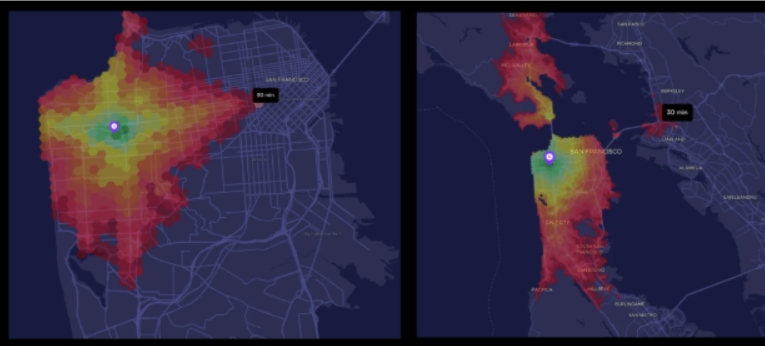
The point of this comparison isn’t to say that public transit has to be strictly faster, but that each extra minute of transit time can lead to more folks choosing to drive. Thus, we have an unfortunate cycle where poor transit leads to more cars on the road, and the increase in traffic slows down buses and trains. All in all, slow public transit is often a policy choice that prioritizes cars and not a physical limitation of our streets.
The nuts and bolts of making Muni faster
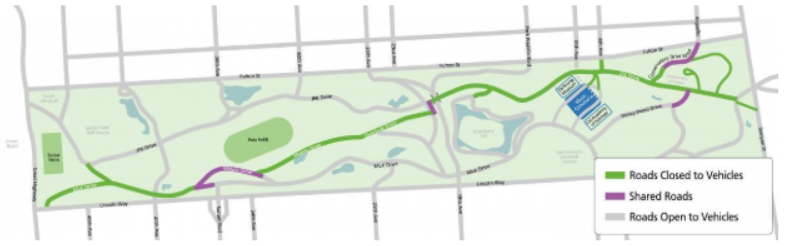
The good thing is that SFMTA already knows this. In 2022, the board of supervisors approved the Golden Gate Park Access and Safety Program. A key result of the plan was focused on implementing the voter-approved JFK Promenade, opening up a transformative new, people-centered pathway through Golden Gate Park. Coupled with the Wiggle and Slow Page Street, among other bicycle routes, the promenade created a low-stress, incredibly popular way for anyone to bike or roll to the park.
SFMTA can and should do more!
The main artery of transit to the park is the N Judah. Beyond serving the park, the N is SFMTA’s most popular Muni Metro route, and provides crucial regional connections to BART and Caltrain, as well as all regional buses, via the Salesforce Transit Center.
SFMTA is evaluating improvements such as modifying stop spacing, adding spot treatments, and adding boarding islands. But implementation may take until 2031.
SFMTA should think bigger. Back in 2017, the SF Transit Riders Union analyzed how five motorists had driven into the N Judah tunnel that year alone, causing massive delays, and how generally slow the section near Duboce Park is. They proposed full transit lanes as a quick-build option, and beyond that, a subway to continue from Van Ness to Carl/Cole.

SFMTA didn’t follow through on those big ideas, but we have another chance to weigh in. Fill out this survey to give SFMTA your feedback and tell them you want a faster Muni, one that is more competitive with driving. Muni needs to be more frequent and go faster end-to-end so that it can better integrate with someone’s larger transit journey to the park.
In 2026, the voters have once again given SFMTA a strong mandate to continue running our trains and buses with the passing of Prop H and the Regional Transit Measure. SFMTA should return to the voters with a vision for the future that makes it a no-brainer to take transit to the park. That means miles of full red transit lanes, new subways, and more frequent and faster buses to help our city move beyond arguing about parking.
***
Pranav Harath is an advocate with SF YIMBY, the San Francisco Transit Riders, and Streets Forward.